Hassabis cuts his AGI forecast to 2-3 years, and his warning of a safety accident by then matters more

🕒 Published on Zendoric: October 23, 2026 · 00:20
✨ AI-generated · how it's made
Demis Hassabis has long been one of AI's most careful voices. In a Wall Street Journal interview, as reported by 36Kr, he now says AGI could arrive in two to three years. In less than two years his forecast has shrunk from 'five to ten years'. The same week, he warned that weak safety standards could lead to a serious accident on roughly the same timeline.
📚 Go deeper

DeepMind co-founder on the dilemma of containing technologies that do not want to be contained.
As an Amazon Associate, Zendoric earns from qualifying purchases; the price does not change for you. · all our recommended books →
Demis Hassabis, CEO of Google DeepMind and a Nobel laureate, now says artificial general intelligence (AGI) could arrive in two to three years. That is according to 36Kr's account of an in-depth interview with The Wall Street Journal. AGI means AI that matches the full range of human thinking. Our thesis: the shrinking forecast is a meaningful signal because it comes from one of the industry's most conservative voices. It is still a forecast, not proof. And his own safety warning is the more urgent part of the message.
The pace of the shift is striking. According to the report, Hassabis said in 2023 that AGI might come 'in a few years, or within ten years'. He also said that in his early career he expected it to take 30 to 50 years. In January 2025 he put it 5 to 10 years away and said the technology might still need 'one or two major breakthroughs'. In February this year he said it was likely within five years. In April, at the HSG AI Ascent conference, he named 2030. Now he says two to three years. The outlet says what he saw inside DeepMind's labs explains the change. That is the outlet's interpretation, not something the material shows.
His definition of AGI is demanding. Hassabis does not mean a tool that is good at certain tasks. He means a system with all human cognitive abilities, including truly original thought. His proposed test is what he calls the 'Einstein Test'. Give an AI all human knowledge up to 1901. Can it, by its own reasoning, derive the physics Einstein published in 1905? The source also quotes him saying AI is still a few years away from independently inventing modern physics. That sits somewhat awkwardly with the two-to-three-year headline, and it suggests the most ambitious version of his definition is still further out.
The interview also describes his track record and his mission. AlphaGo beat Lee Sedol in 2016. AlphaFold solved the 50-year-old protein folding problem in 2020 and predicted more than 200 million protein structures. He then founded Isomorphic Labs, an AI drug discovery company inside Google, to change how medicines are developed. His pattern, he says, is that progress is 'very slow, very slow, very slow' and then arrives all at once. He summarizes his mission in two steps: solve intelligence, then use it to solve everything else.
Our reading: the most important line was not about AGI. At a summit in Dublin a week before the interview, Hassabis warned that if governments and companies do not significantly raise safety standards, the industry could face a serious safety accident in about two years. 'It's not all disaster, and it's not all paradise,' he said. This matches our view that the most concrete risk is short term: misuse, accidents and automated fraud. Distant superintelligence scenarios are a less pressing concern. It is notable that a lab leader puts capability and risk on the same calendar.
The long-term horizon fits our editorial line. Hassabis is one of the few leaders who has shown, with AlphaFold, that AI can speed up science that saves lives, and his goal of eradicating disease has concrete evidence behind it. Still, a forecast is not a demonstrated capability, and leaders at well-funded labs have reasons to sound bold. What we will watch in the next two years: whether a system passes something like his Einstein Test, and whether the safety standards he called for actually get adopted. If safety does not keep pace with capability, the accident he warned about becomes more likely.
📚 Go deeper

AI as the latest chapter in the history of information networks, from gossip to the printing press to the algorithm.
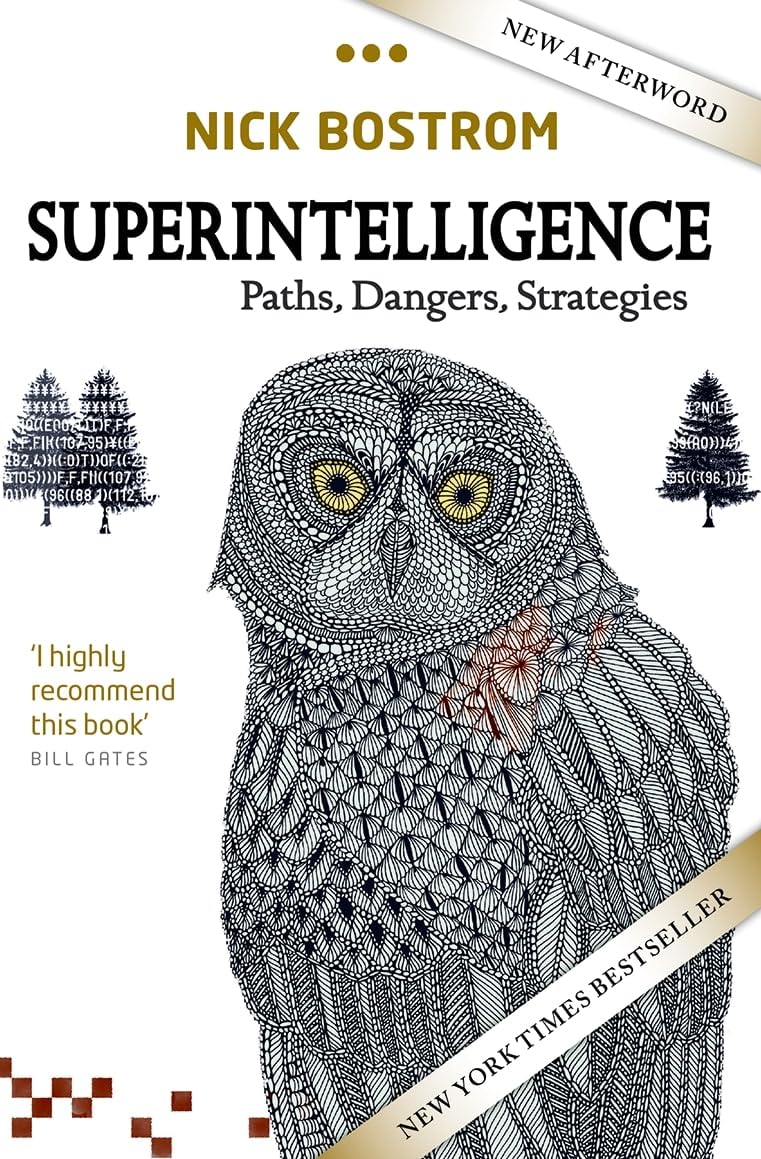
The book that started the existential-risk debate and that half the industry still cites.
As an Amazon Associate, Zendoric earns from qualifying purchases; the price does not change for you. · all our recommended books →
🔗 Related on Zendoric
- Hassabis sets a clock on AGI: 'a few years,' and calls for a FINRA for AI before it's too late · 2026-07-15
- Three seconds of audio is enough: AI voice fraud's flaw is that every defense arrives after the money is gone · 2026-07-28
- Anthropic researcher quits citing 'out-of-control' AI fears — internal dissent is becoming the safety signal that matters · 2026-09-09