HPE will take its Spaceborne Computer-4 to the Moon with AI and HPC aboard Astrolab's FLIP rover
🕒 Published on Zendoric: October 22, 2026 · 00:19
✨ AI-generated · how it's made
HPE has announced that its Spaceborne Computer-4 will run artificial intelligence workloads on the lunar surface. According to the company, it will also be the first high-performance computing (HPC) benchmark performed on the Moon.
📚 Go deeper

The story of NVIDIA and Jensen Huang: how a video-game card company ended up making the most coveted resource on the planet.
As an Amazon Associate, Zendoric earns from qualifying purchases; the price does not change for you. · all our recommended books →
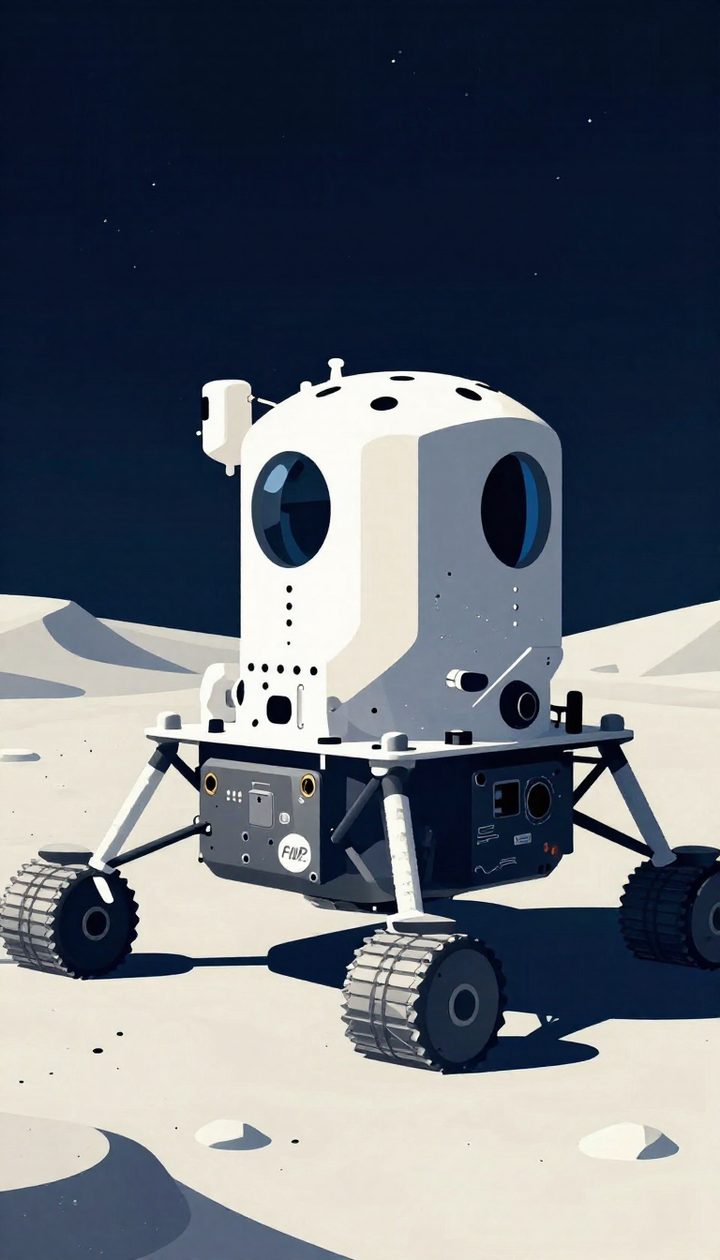
HPE has announced that its Spaceborne Computer-4 will run artificial intelligence workloads on the lunar surface. According to the company, it will also be the first high-performance computing (HPC) benchmark carried out on the Moon. The module will travel aboard Astrolab's FLIP rover, which will land near the lunar south pole as part of NASA's CLPS (Commercial Lunar Payload Services) initiative. HPE's space program thus moves from the International Space Station to an environment with no atmosphere and far greater radiation exposure.
The mission is scheduled for late 2026 aboard Voyager Technologies' Griffin-1 lander. Once deployed, the Spaceborne Computer-4 will run retrieval-augmented generation (RAG) with a large language model, vision inference, LiDAR data processing for mapping and navigation, and an AI services container. The container is meant to show that scalable AI applications can be deployed reliably at the lunar edge.
The hardware is much smaller and lighter than the Spaceborne Computer-1 of a few years ago. That makes sense, because mass is a critical factor for lunar payloads. The goal is a low-mass, low-power compute subsystem that can make decisions locally rather than sending everything back to Earth. It is a compact, fanless module. Since there is no air on the Moon to flow over a heatsink, it uses a space radiator and a lattice-structured enclosure. According to HPE, it is lightweight and self-contained, and has a low-power CPU and GPU. The article notes that it can be lifted by hand. It is designed to withstand launch vibrations and the lunar thermal environment.
For storage, it uses a Kioxia BG-series M.2 SSD. This is the same class of DRAM-less drive found in low-cost mini PCs. Kioxia has spent years testing commercial NAND on the ISS, and this mission extends that work to the Moon's harsher radiation environment. HPE has also prepared software to optimize interaction with Earth-based resources and to return results securely from the Moon. It will also support Astrolab's mission control in Hawthorne, California, with HPE Private Cloud and HPE CloudOps Software to manage and automate workloads from Earth.
NASA and Deloitte are joining the mission with additional AI payloads. NASA will run its FLUID (Federated Learning for Unbounded and Intelligent Decentralization) experiment, which coordinates three different AI models trained on data from Earth, the Moon and the ISS. It will also test a fine-tuned LLM with semantic processing capabilities that can search and interpret documents on board. Deloitte's Silent Shield system will provide predictive cybersecurity analytics and near-real-time anomaly detection.
The outlet's view is that, if the benchmarks go as expected, they will show whether commercial-grade components can support the emerging lunar economy without expensive custom space-grade silicon. The outlet hopes the mission succeeds, as long as the hardware actually powers on at the lunar surface. It notes that, given the cost of lunar launches, everything is tested thoroughly before it is loaded onto the rocket.
📚 Go deeper

Semiconductors as the oil of the 21st century: history, espionage, and why an island of 23 million people underpins the entire AI economy.

The reference manual for building products on top of AI models: prompts, RAG, fine-tuning, agents, evaluation and deployment.
As an Amazon Associate, Zendoric earns from qualifying purchases; the price does not change for you. · all our recommended books →
🔗 Related on Zendoric