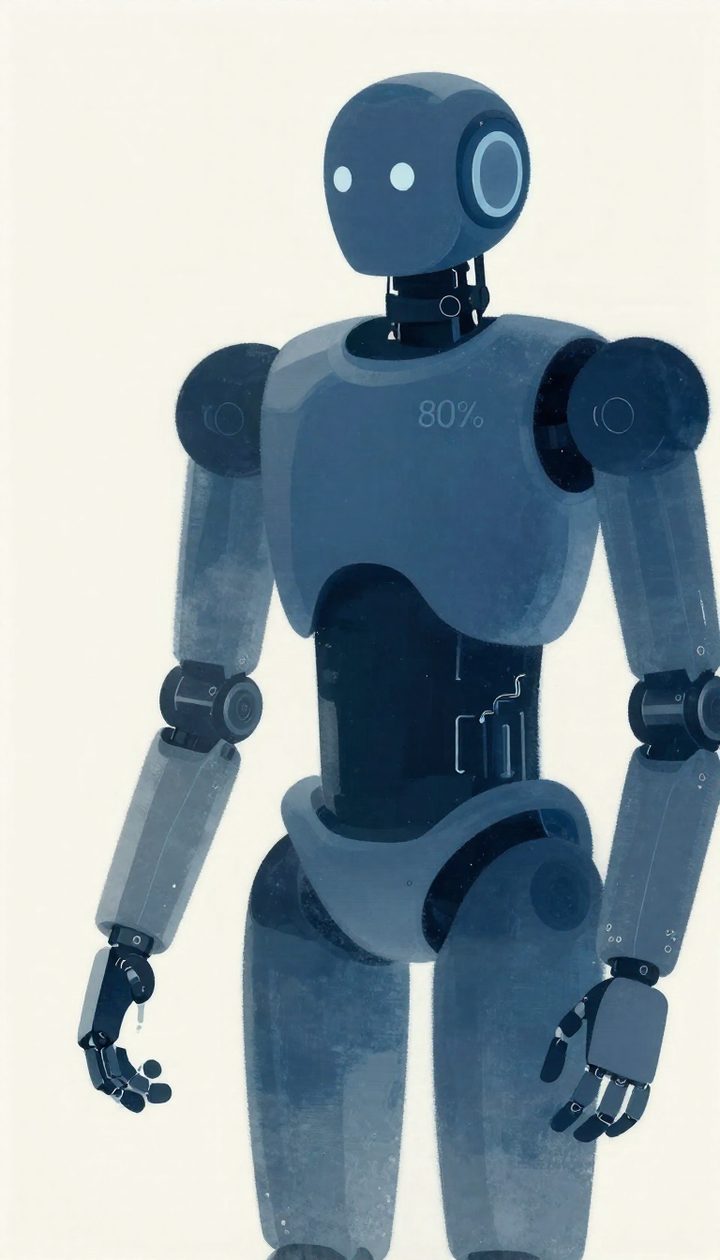
Robots and AI could cover 80% of work in the US, but they're cheaper than a person in only 0.3% of tasks
🕒 Published on Zendoric: October 18, 2026 · 11:06
✨ AI-generated · how it's made
An Anthropic study estimates that AI and robots together could cover 81% of US work. But cost, not technology, is the real brake: today only 0.3% of tasks are cheaper with a robot. That gap sets the pace of the transition.
📚 Go deeper

The best starting book if you're not technical: a Wharton professor explains how to work WITH AI — when to delegate, when to supervise, when to keep i
As an Amazon Associate, Zendoric earns from qualifying purchases; the price does not change for you. · all our recommended books →
By The Next Web · October 17, 2026.
AI models and robots together could take on around 81% of the work Americans do, according to a new robotics study from Anthropic. AI models alone reach about half. Even so, robots are cheaper than people in only 0.3% of tasks today. The Next Web reported the findings, citing the study as covered by Business Insider.
The study builds on the company's earlier research into how chatbots affect jobs. Its most striking finding is that robots reach physical, lower-paid jobs that chatbots don't touch, which reverses the usual pattern for AI. In transportation, fewer than 15% of tasks are exposed to AI models alone. With robots, that figure jumps to nearly 90%. Nine of the ten most exposed jobs are vehicle drivers, with taxi drivers at the top.
The key caveat is feasibility. According to the study, robots can technically perform about 74% of physical tasks, but mostly only in highly controlled settings such as an assembly line. Cost is the biggest barrier. About 300,000 US workers hold jobs where a robot is already cheaper, mostly packers. If robot prices fell by 20%, that figure would rise to about 2.8 million. At the historical pace, reaching 10% of tasks would take about 40 years.
There is also a methodological caveat worth stressing. According to the study itself, the assessments were made by Claude using web search, and Anthropic insists that exposure does not equal job loss. Business Insider journalist Alistair Barr was skeptical about the case of gardeners. The study ranks cleaning and maintenance among the largest increases in exposure, yet it also notes that cleaning robots tend to be slower than people and several times more expensive.
Our take: the 80% figure is a theoretical ceiling, and the number that matters is 0.3%. That gap is the difference between proven capability and aspiration. A study graded by a language model, with all the uncertainty that implies, is a useful compass, not a forecast. Its value is that it shifts the conversation: the risk to physical jobs depends less on whether a robot "can" do the task than on the cost curve.
That has concrete public-policy consequences. If a 20% price cut multiplies the number of affected jobs by nine (from 300,000 to 2.8 million), the transition will not be gradual and linear. There will be thresholds where an entire sector suddenly becomes vulnerable. Drivers and packers would be the first exposed. More broadly, this fits a pattern already visible elsewhere: routine, repeatable work goes first, while work that demands judgment, human connection or dexterity in messy environments holds out longer.
In the short term, then, honesty is in order. Job displacement will be concentrated in low-wage occupations, whose workers have the least cushion to retrain. Training and social protection should be in place before prices cross the threshold, not after. The underlying lesson is that robot economics, not just engineering, will set the timeline.
In the long term, however, the outlook remains favorable. If grueling, repetitive or dangerous physical work is truly automated because it is cheaper, the payoff is abundance: cheaper goods and services for everyone, and people freed to pursue what they are passionate about. Forty years to reach 10% of tasks, based on past trends, is a reminder that this won't happen tomorrow. Paradoxically, that slow pace is an opportunity: time to design the transition based on evidence rather than panic.
📚 Go deeper

The memoir of the creator of ImageNet, the scientist who made the deep learning revolution in vision possible.

How opaque algorithms decide who gets credit, a job or parole — and why they tend to punish the same people.
As an Amazon Associate, Zendoric earns from qualifying purchases; the price does not change for you. · all our recommended books →
🔗 Related on Zendoric
- An Anthropic study suggests robots are decades away from replacing manual workers · 2026-10-03
- AMD rewrites its AI roadmap around agentic orchestration and challenges Nvidia's reign in the data center · 2026-07-24
- Ubtech sells a robot to fall in love with for 158,000 euros: the real business is frictionless AI validation · 2026-07-26