Lakeland buys $22M in drones and AI from Axon: local police become a 10-year software platform
🕒 Published on Zendoric: October 13, 2026 · 00:19
✨ AI-generated · how it's made
Lakeland (Florida) signs a $21.9M ten-year deal with Axon for autonomous drones, AI report-writing and cameras. The real-world case is a drone rescue; the underlying question is who audits the software and what data it retains.
📚 Go deeper

The definitive piece of investigative journalism on OpenAI: 260+ interviews, the clash between safety and speed, and the attempted firing of Sam Altma
As an Amazon Associate, Zendoric earns from qualifying purchases; the price does not change for you. · all our recommended books →
By WFLA (Tampa Today) · October 12, 2026.
City commissioners in Lakeland, Florida, unanimously approved on October 5 a $21.9 million, ten-year contract with Axon Enterprise, WFLA reports. The deal covers additional drones, artificial intelligence software and upgrades to body cameras, patrol car video and Taser stun guns.
The contract is roughly double the city's previous agreement with Axon. According to Police Chief Sam Taylor, about $10 million had already been committed under the existing agreement, and the expansion will be funded mainly through grants and existing resources, with no additional cost to taxpayers expected. That is his claim; it should be verified once the budget line items are published.
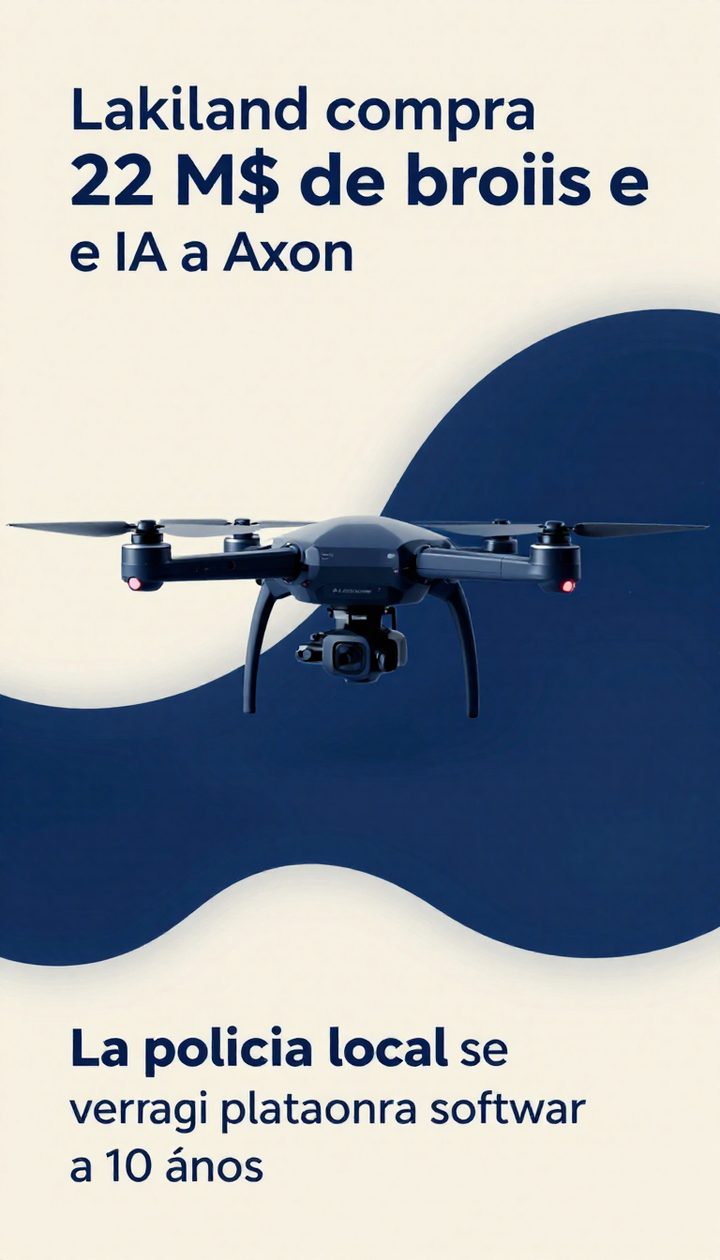
The operational side is the most striking. The department currently has eight drones that officers must launch and fly in the field. The contract adds three remotely deployed drones with rooftop docking stations (bases where the aircraft waits and recharges). They will take off in response to emergency calls and be piloted by staff from the police station, with live video for officers en route. Taylor gives an example: seeing whether a crash is still blocking an intersection before deciding what resources to send.
The second piece is the AI software. According to Taylor, it uses audio from body cameras to identify speakers, transcribe conversations and draft police reports. Officers must review, correct and approve each report. It also includes translation in more than 60 languages, which Officer Mark Pothier considers useful on calls in Haitian Creole and Spanish.
The case being used as an argument is real and compelling. Last month, a drone with a spotlight guided officers through a swamp to two children (a 10-month-old baby and a 2-year-old) after a traffic crash; both were discharged from the hospital. The driver, Isaac Kinsey, was arrested and faces charges, including two counts of child abuse; these are accusations, not convictions. Taylor maintains that without the drone the outcome could have been very different.
**Our take.** This is the local example of a broader trend: value is shifting from hardware to software and the contract. A police department that buys drones, cameras, Tasers and AI from the same vendor for ten years is not acquiring tools; it is adopting a platform. In general, in the public sector these kinds of deals create a dependency that is hard to reverse: data, formats and workflows become tied to the vendor. Ten years, in AI, spans several generations of models.
The benefits are tangible and we stand by them. Cutting paperwork puts hours back on the street, and a drone that arrives before the patrol car can save a life, as in the swamp. It is the kind of automation of administrative tasks that, in the long run, frees up human time for what requires judgment and presence.
But the regulatory checkpoint is no longer what the model says, but what it sees and what it decides. An AI-generated draft report is the first official account of an event. If the officer is in a hurry, human review can become a rubber stamp, and transcription errors (accents, languages, noise) would end up in a legally binding document. The sensible approach would be to require that the original audio be preserved, that generated text be flagged, and that audit logs be accessible to the defense.
Privacy deserves the same precision. Taylor says the drones will respond to emergency calls and will not routinely surveil private property, and that policies and state law limit their use, including when a warrant is required. These are internal policy commitments. In general, the risk with these fleets is mission creep: what starts out for rescues ends up being used for almost everything. The real safeguard is public rules, video retention limits and independent audits, not the good faith of the current leadership.
In the short term, we will see more mid-sized cities buying similar packages, and the debates will play out in city council meetings with little technical scrutiny. In the long term, technology can make public safety faster and less risky for everyone. To get there, the contract matters as much as the algorithm.
📚 Go deeper

DeepMind co-founder on the dilemma of containing technologies that do not want to be contained.

AI as an extractive industry: the lithium, the energy, the underpaid data-labeling work and the bodies behind the cloud.
As an Amazon Associate, Zendoric earns from qualifying purchases; the price does not change for you. · all our recommended books →
🔗 Related on Zendoric
- AI cameras to detect weapons in schools: a useful patch that doesn't solve the underlying question · 2026-07-17
- WhatsApp is about to become an agent console, and the messaging app becomes the AI interface · 2026-09-08
- Anthropic flagged a Claude chat and Florida police made an arrest. The chatbot-as-diary era just ended · 2026-10-07