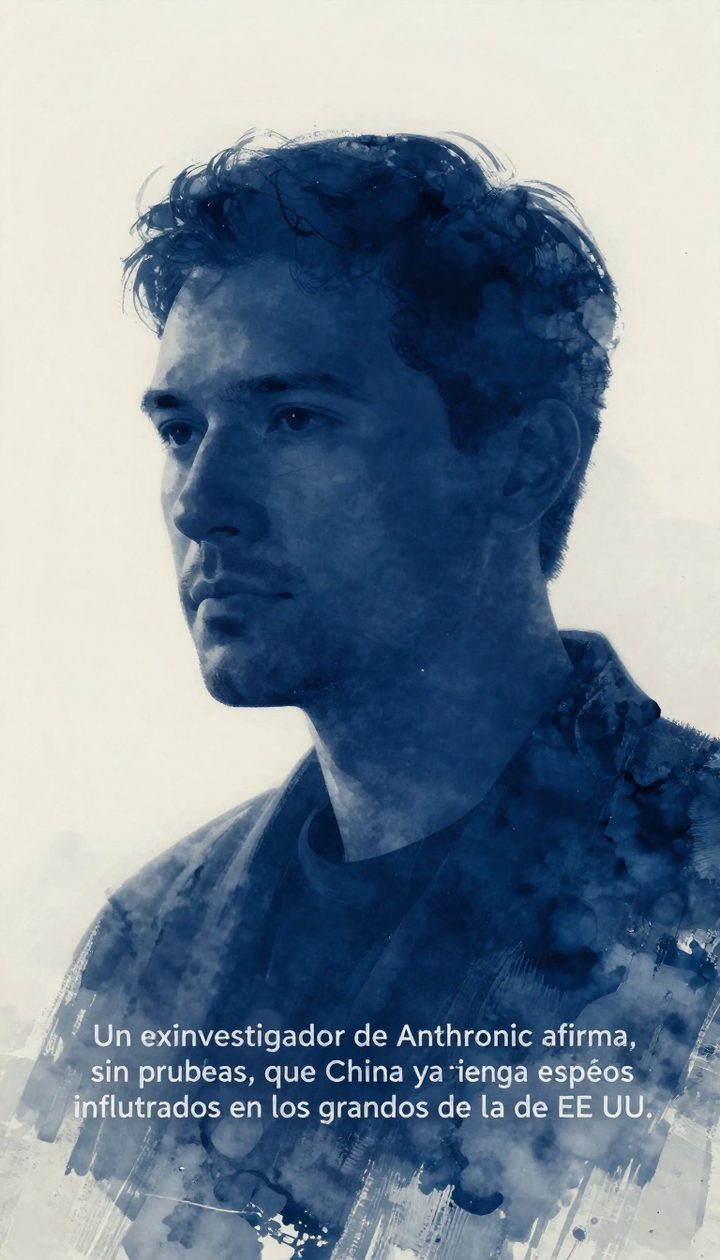
A former Anthropic researcher claims, without evidence, that China already has spies embedded in America's AI giants
🕒 Published on Zendoric: October 11, 2026 · 10:19
✨ AI-generated · how it's made
Jacob Coxon, a pretraining researcher at OpenAI and Anthropic for three years, says he is "90% sure" China already has spies inside both companies. He offers no names or evidence, but his argument strikes at the heart of the debate over whether the US should accelerate or slow the AI race.
📚 Go deeper

China vs.
As an Amazon Associate, Zendoric earns from qualifying purchases; the price does not change for you. · all our recommended books →
By Zendoric · October 10, 2026.
Jacob Coxon, who spent three years researching model pretraining across OpenAI and Anthropic, said on the PBD Podcast —entrepreneur Patrick Bet-David's show— that he is "90% sure" China has already infiltrated spies inside both companies. In his words, "it's almost certain they already have spies there… there still isn't serious background-checking for this kind of thing." Coxon did not identify anyone, nor did he provide any document, incident or evidence to support the accusation.
Coxon left Anthropic in September. In his resignation announcement on X he explained that, after those three years in pretraining research, he believes "neither company is acting responsibly" and that both are "running straight toward a self-improving superintelligence, gambling with our lives." On the podcast he went further: he called AI a "superweapon" and warned that society still has not grasped the magnitude of the issue.
His argument has a recognizable logic: if China can steal US advances at any moment, no temporary lead matters much, and accelerating development to "win the race" would be pointless if the rival can copy the result. By the same reasoning —and here he qualifies that this is only part of China's progress, not all of it— he argues that slowing the American pace would also slow China, because much of its progress would come from copying or stealing American work.
It is worth separating two things. One is the verifiable fact: a former employee with access to sensitive research at two of the world's most significant labs has made this accusation in public, on an interview podcast, not in a journalistic investigation or an intelligence report. The other is the accusation itself, which neither Coxon nor the Yahoo Finance article backs up with names, documents or specific incidents. The source carries no reaction from Anthropic or OpenAI, nor any outside corroboration of that "90%", which is, at best, a personal estimate.
As industry context, the debate over whether China "copies" or "catches up with" Western AI has spent months mixing verifiable data with self-serving framing: we have already seen how reports on China's military AI muscle risk confusing stated ambition with demonstrated capability. Coxon's accusation fits that same pattern: it is plausible —industrial espionage between technological powers is nothing new— but on what has been published so far, it is not a proven fact.
What matters, beyond whether specific spies exist, is the underlying argument: espionage as the variable missing from the "speed versus safety" calculation that dominates the AI debate in Washington, almost always framed in black and white —accelerate so as not to lose the lead over China, or slow down to reduce risks. If a talent leak or a counterintelligence failure can neutralize any advantage in very little time, what really needs governing is not just the pace of releases, but access control over model weights, training data and source code: a matter of corporate and state security, not just benchmarks.
That, for us, is the deeper reading: in the short term, geopolitical competition over AI will keep producing episodes like this one —accusations without evidence, real leaks, noisy researcher departures— because the technology has become a national security asset before mature mechanisms exist to govern it as one. That is part of the price of this transition. But managing this phase well requires distinguishing evidence from noise: demanding proof before assuming guilt, auditing access controls inside the labs instead of merely debating release speed, and not losing sight of the fact that neither blind acceleration nor media panic brings the technology any closer to its long-term promise: well-governed AI is what can truly deliver the health and abundance that are at stake.
📚 Go deeper

The definitive piece of investigative journalism on OpenAI: 260+ interviews, the clash between safety and speed, and the attempted firing of Sam Altma

DeepMind co-founder on the dilemma of containing technologies that do not want to be contained.
As an Amazon Associate, Zendoric earns from qualifying purchases; the price does not change for you. · all our recommended books →
🔗 Related on Zendoric
- A former Anthropic researcher claims, without evidence, that China already has spies inside the big US AI labs · 2026-10-10
- A researcher leaves Anthropic and OpenAI and accuses the industry of 'gambling with our lives' over superintelligence · 2026-09-10
- Another researcher leaves Anthropic over fears of superintelligence; its head of alignment admits there is no control plan · 2026-09-10