VLA vs. World Action Models: should robots react or imagine?
🕒 Published on Zendoric: October 11, 2026 · 10:19
✨ AI-generated · how it's made
This issue of Turing Post is a guide devoted to a new family of robotics models called World Action Models (WAM), and to how they differ from the already familiar Vision-Language-Action models (VLA).
📚 Go deeper

The only novel on the list, by a Nobel laureate: an artificial friend observes humans with a blend of lucidity and innocence no essay achieves.
As an Amazon Associate, Zendoric earns from qualifying purchases; the price does not change for you. · all our recommended books →
By Turing Post · October 9, 2026.
This issue of Turing Post is a guide devoted to a new family of robotics models called World Action Models (WAM), and to how they differ from the already familiar Vision-Language-Action models (VLA). The email opens with a piece of context: world models have brought AI closer to understanding how the physical world works, but the question the newsletter poses is what to do with that understanding once it exists — that is, how to move from predicting what will happen to acting accordingly. WAMs are presented as the class of models that attempts to join those two capabilities: predicting how the world changes and, at the same time, deciding what action to take on the basis of that prediction.
According to the email itself, for a model to be considered a WAM it needs two components: a prediction of the future (which can take the form of an image, a video, optical flow, a point cloud or a learned latent representation, that is, a compact numerical description of the predicted state) and an action generation tied to that prediction. The model can either predict the future first and derive actions from it, or generate future states and actions jointly.
The newsletter devotes a section to tracing the origin of the term 'World Action Model'. It notes that NVIDIA's 2026 paper titled 'World Action Models are Zero-shot Policies' popularized the term to distinguish these architectures from VLAs, but clarifies that the concept had been evolving earlier: the term was already used occasionally in 2024 and 2025 to describe models that unify world dynamics and action generation. It also mentions that Jürgen Schmidhuber laid the conceptual foundations of these world-controller models as far back as 1990, although the email explicitly clarifies that he was not the one who coined the term as it is used today.
The text reconstructs the chronology of that origin with three concrete milestones cited in the body of the email. The first is October 1, 2024, when Jie Cheng and colleagues published 'Scaling Offline Model-Based RL via Jointly-Optimized World-Action Model Pretraining', presenting the JOWA model, trained on Atari games with a shared transformer backbone jointly optimized with world-modeling and temporal difference (TD) losses, in order to learn both the dynamics of the environment and the value of actions. The second milestone is March 21, 2025, with the paper 'DyWA: Dynamics-adaptive World Action Model for Generalizable Non-prehensile Manipulation', by Jiangran Lyu and colleagues from Peking University and Galbot, which uses the term in a robotics context as a policy model that jointly predicts the robot's actions and their corresponding future states, using that future-state prediction as an additional training signal.
The third milestone, and the one the email describes as the most popular paper on WAMs, is DreamZero, presented by NVIDIA's research team on February 17, 2026 in the paper 'World Action Models are Zero-shot Policies'. DreamZero is, according to the email, a WAM built on a pretrained video diffusion model that jointly generates future video frames and actions; in other words, it learns to predict what a robot's actions will look like and which motor commands will produce them, all at once. The email cites Seonghyeon Ye, Yuke Zhu, Jim Fan and Joel Jang as the project's leads, and expressly clarifies that, although it makes sense to associate WAMs with Jim Fan and NVIDIA given DreamZero's impact, it would not be accurate to say they were the first to coin the term. It also includes an image of the model's architecture, credited to NVIDIA's own paper.
The central part of the email explicitly compares the principles of VLA and WAM. According to the text, a VLA learns to answer 'what action or sequence of actions should I take?', while a WAM learns to answer 'what is going to happen in the world, and what action takes me to the future I want?'. The email lays out a comparison table along several axes: on the main question, VLA focuses on 'what should I do' and WAM on 'what will happen if I do this' plus 'what should I do'; on the typical foundation, VLA starts from a vision-language model (VLM) and WAM from a world or video model; on the learning focus, VLA goes from semantics to action and WAM combines dynamics and action; on the output, VLA produces a robot action or sequence of actions, whereas WAM produces an action together with a future state or representation, or an action informed by the learned world dynamics; on strengths, VLA excels at generalization through language and meaning, and WAM at physical and spatiotemporal dynamics; and as an analogy, the email sums up VLA as 'perceive → act' and WAM as 'imagine → act'.
The newsletter announces that it was going to break down this distinction with a concrete practical example for a robot (the task of 'picking up the cup and putting it in the sink'), but at this point the email is cut off by a paywall: the text explicitly states 'you need to read it to really understand the difference' and refers premium subscribers to the rest, so the development of that example and the later sections listed in the table of contents (cascaded WAMs, joint WAMs, how DreamZero connects video prediction with robot control, how video models represent robot commands, whether WAMs generalize better than VLAs, and the closing question of whether robots should react or imagine) are not developed in the body received.
As additional content not directly related to the main topic, the email includes an aside pointing to a Turing Post YouTube video about Open d1, a family of decision models from Liquid AI, presented as an alternative for anyone not interested in the WAM topic; the email offers no further details about that model beyond mentioning its existence and linking the video. The email also links to the previous episode in the series, devoted to how world models work in general (from Dreamer and JEPA to Waymo and Atlas), and closes with the newsletter's usual elements, such as the referral link to get a month of premium subscription.
📚 Go deeper
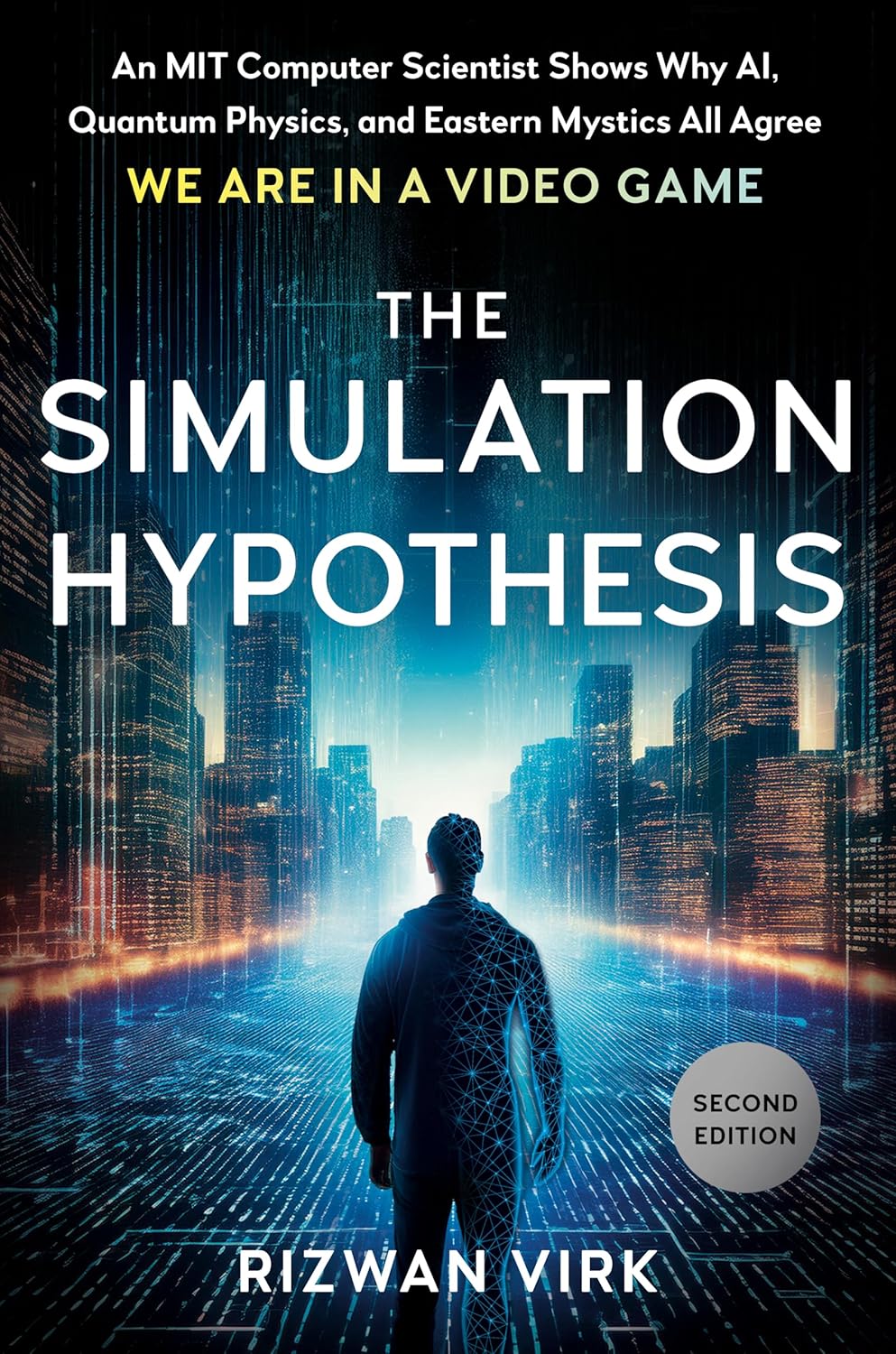
An MIT computer scientist connects AI, quantum physics and video games to take an uncomfortable question seriously: what if we live in a simulation? M

The story of NVIDIA and Jensen Huang: how a video-game card company ended up making the most coveted resource on the planet.
As an Amazon Associate, Zendoric earns from qualifying purchases; the price does not change for you. · all our recommended books →
🔗 Related on Zendoric