Dyna-2.1: Dyna Robotics' Taku humanoid robot learns to run entire workflows unsupervised
🕒 Published on Zendoric: October 3, 2026 · 02:03
✨ AI-generated · how it's made
Dyna Robotics has unveiled Dyna-2.1, a system the company describes as its first "physical agent" capable of running a complete workflow end to end — not an isolated task — for hours without frequent human intervention.
📚 Go deeper

The story of NVIDIA and Jensen Huang: how a video-game card company ended up making the most coveted resource on the planet.
As an Amazon Associate, Zendoric earns from qualifying purchases; the price does not change for you. · all our recommended books →
Dyna Robotics has unveiled Dyna-2.1, a system the company describes as its first "physical agent", capable of executing an entire workflow end to end —not an isolated task— for hours without frequent human intervention. The announcement comes with a new semi-humanoid robot called Taku (from the Japanese takumi, "master craftsman") and an hour-long uncut video in which the system autonomously completes the work cycle of a hotel laundry room: loading washers, moving laundry to dryers, folding towels, stacking them and carrying them to shelves.
The article's central argument is a distinction the company considers key to the robotics business: there is an enormous difference between a robot performing a stationary task well (folding napkins, for example) and replacing a person in a complete role. As they explain, their previous generation, DYNA-1, was already able to fold napkins for 24 hours without failing at that specific task, but it needed a human to continuously refill the napkin bin and remove the finished stacks. As soon as that person stepped away, the flow stopped even though the skill itself worked perfectly. The conclusion they draw from talking to customers is that customers do not pay for a task, but for a role: they want a robot that covers a full shift without a second, permanently assigned support employee.
To achieve this, they identify three capabilities that, in their view, no single action model on a limited hardware platform can solve in isolation: expanding the robot's physical workspace (because today's workflows are designed for human bodies that use base, torso and arms together at every station); teachability, that is, the ability to learn new skills quickly and make them reliable from human data, simulation and corrections gathered on the job itself; and reasoning, which is necessary because real workflows are not linear but demand constant conditional decisions. That is why they chose to build what they call a full-stack "physical agent", from hardware design to the learning of robust policies.
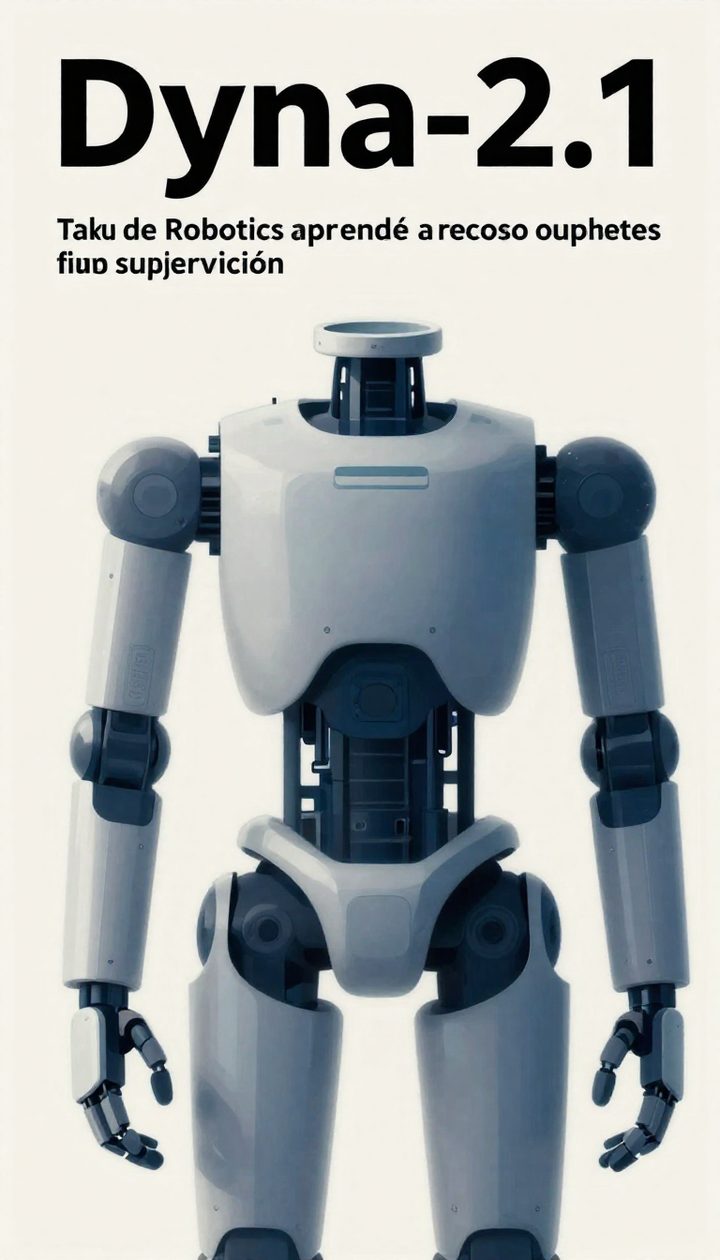
The Taku robot is the hardware piece of this proposal: a human-shaped body above the waist, a folding lower section that lets it reach very low or very high points, a stable base on four steerable wheels (instead of legs) and two arms with seven degrees of freedom each. The company explains that, since most of the steps in the workflows it cares about require reach and manipulation precision rather than bipedal locomotion, it opted for wheels instead of legs. The robot's size above the wheels is calculated to approximate that of an average person, so that the wrists, elbows and chest recorded when tracking a human fall close to postures Taku can also reach. The arms also use low-reduction-ratio planetary actuators —instead of the harmonic drives common in robotic arms— to achieve speeds and accelerations closer to human movement. The example they give is illustrative: in the laundry room, the robot has to lean into a dryer drum at arm's length, reach into the washer to retrieve a forgotten towel, twist at the waist while carrying a load, and crouch down to the lowest shelf or stretch up to the highest, all across stations several meters apart. They call this loco-dexterous manipulation, a combination of coordinated whole-body movement and fine manipulation that, they argue, is very hard to achieve with a fixed bimanual arm on a table or with lift-style mobile manipulators.
The article insists that having physical reach across all stations is only the first problem. The real challenge of the laundry workflow, they say, is twofold. On the one hand, it chains hundreds of subtasks over a shift: in an hour many small failures occur —a gripper that picks up two towels at once, a corner that folds badly, a stack that tips— and some of those failures undo previous work (a dropped towel has to go back in the washer; a toppled stack sends every towel it held back to the start). The company acknowledges it chose laundry precisely because most of its failures are recoverable, but every recovery costs time and, even so, every step must avoid irreversible errors, so per-step reliability compounds relentlessly. They illustrate this with a calculation: if each of the roughly 79 steps in a cycle has 95% individual reliability —a figure that in many industrial contexts would be considered good— the probability of the full cycle finishing without human help drops to barely 1.7%, which in practice translates into about 190 human interventions every 24 hours, or one every eight minutes. It is a powerful argument for why aggregate reliability, and not just the reliability of an isolated skill, is the real bottleneck in general-purpose robotics.
The second problem is that the workflow is not linear. Although towels follow a simple sequence (washing, drying, folding, stacking), the robot cannot follow that same sequence rigidly: each machine finishes on its own schedule, and a machine that finishes and sits waiting with no one attending to it is lost capacity. This forces folding to be an interruptible task: the robot must monitor the machines while folding laundry and attend to each one as soon as it finishes. The article breaks a full cycle down into thirteen decision points, several of which depend on information the robot observed minutes or hours earlier but that is no longer visible at the moment of deciding —for example, when the washer started, which load is in which machine, or which shelf has free space— which requires a form of medium-term working memory that goes beyond immediate perception.
To solve these two problems, the system is organized into three layers of models, each operating on a different time scale. The first is a whole-body controller, trained with reinforcement learning in simulation, that turns target trajectories in task space (positions of wrists, elbows, chest and base, a format they call the Unified Robot Representation, or URR) into concrete joint commands and wheel velocities, at a frequency of 100 Hz. The second layer is the DYNA-2 policy, an improved version of the world-action model they presented earlier, which translates the current step of the workflow into those whole-body target trajectories, operating at about 5 Hz. The third layer is a workflow orchestrator, built on a vision-language model, which tracks the state of the workflow, decides what the next step is and directs the DYNA-2 policy to execute it.
The most developed part of the available material focuses on the concept of teachability: how cheap and fast it is to bring a new skill, or an adaptation to a new customer's procedure, up to production-level reliability. The company stresses that robot data is the scarcest resource of all —it costs robot and operator hours, and every hardware revision partly obsoletes data collected before— while the amount of recorded human experience (video, motion capture, handheld-gripper demonstrations) keeps growing. It states that, thanks to its advances in teachability, some stationary folding deployments already reach production level at a new site in just three days, compared with the weeks or months of on-site engineering previously required. With Dyna-2.1 they say they go further, learning new skills with far less prior demonstration, and they offer as examples two new skills shown on video: servicing a computer server and fetching a drink.
To achieve this they describe three design decisions. The first is making human data directly usable by robots through that unified representation (URR), which describes a body by the positions of wrists, elbows, chest and base in a consistent local reference frame. According to the article, this representation has three properties: it is agnostic to body morphology (it works equally for a human, a humanoid, a semi-humanoid robot like Taku or a bimanual tabletop arm, using more or fewer body components depending on what is present), it captures the spatial constraints most relevant to coordinated manipulation (hand position, arm configuration, torso posture and location in the workspace) and it is reversible with respect to equivalent action formats, provided the reference frame and the initial pose are preserved. The difference from other whole-body teleoperation systems, they note, is that those usually first fit the human motion to the robot's specific joints before a tracking controller acts, which —when learning from video— can push the target hand away from the object it actually touched in the original video, creating a mismatch between the image and the action label. By keeping the demonstrated motion in task space as the target and delegating joint coordination to the controller, they avoid that problem, and in the process get live teleoperation, egocentric recordings and UMI-type device demonstrations all to enter through the same data pipeline.
According to the text, both the action model (the DYNA-2 policy) and the reinforcement learning controller are trained on human motion converted into this URR format. The policy is pretrained on a million hours of human video combined with data from the company's own robot fleet, using as targets the whole-body poses extracted from the video, so that subsequent fine-tuning with real robot data only has to teach it the specifics of Taku's particular body; the human video also exposes the model to towels, machines and rooms its own robot data never covered. As proof that this pretraining works even without additional tuning, they cite that DYNA-2, pretrained on human video alone, passed more than 87% of customer acceptance tests zero-shot on a stationary robot deployed at sites it had no data from, compared with 46% for its previous generation, DYNA-1.
The text also explains that the whole-body controller and the learning task form a self-reinforcing loop: more demonstrations produce a better controller, and a better controller makes it possible to record higher-quality demonstrations to train the policy. The controller learns balance, posture and motion tracking through reinforcement learning in simulation, where trials are cheap, and instead of relying solely on exploration and manual reward tuning, it reuses the enormous volume of URR data as pose targets alongside synthetic targets, in order to inject natural human posture patterns directly into control learning. The company says it has observed that this growing body of human data not only speeds up training convergence, although the document breaks off at exactly that point, before completing the explanation of that benefit and without developing the subsequent sections that the article's own table of contents announces: how the usefulness of old robot data is preserved despite hardware changes, the final result in terms of skill mastery and error recovery, the detailed workings of the vision-language-model-based orchestrator (including its long-term memory), the future outlook section and the list of cited references.
It should therefore be made clear that the content downloaded from the source arrives truncated mid-sentence in the section on controller training, and that this is not a paywall but a break in the capture of the original article. Everything above faithfully reflects what does appear in the available text; any detail about the final sections —teachability in the face of hardware changes, the final reliability balance achieved, the exact design of the orchestrator or the company's conclusions about next steps— cannot be confirmed with the material received and is left out of this summary so as not to speculate about figures, claims or examples that do not appear verbatim in the document.
📚 Go deeper

Semiconductors as the oil of the 21st century: history, espionage, and why an island of 23 million people underpins the entire AI economy.

The best starting book if you're not technical: a Wharton professor explains how to work WITH AI — when to delegate, when to supervise, when to keep i
As an Amazon Associate, Zendoric earns from qualifying purchases; the price does not change for you. · all our recommended books →
🔗 Related on Zendoric
- From being unable to connect the robot to beating it 19 times in a year: AI enters the physical world without being trained for it · 2026-06-29
- New York stopped robot teacher 'Sally' in 24 hours: journalism did it, not the law · 2026-07-28
- Microsoft launches MAI-Cyber-1-Flash, its first AI model for cybersecurity, integrated into MDASH · 2026-07-29