Sanders wants to ban superintelligence with up to 20 years in prison: a law betting it has no object

🕒 Published on Zendoric: October 2, 2026 · 00:19
✨ AI-generated · how it's made
Bernie Sanders proposes banning the development of superintelligence, with sentences of up to 20 years. Analyst Will Lockett welcomes it for an unusual reason: if superintelligence doesn't exist, the law stops nothing real — only the risk narrative inflating IPO valuations.
📚 Go deeper

DeepMind co-founder on the dilemma of containing technologies that do not want to be contained.
As an Amazon Associate, Zendoric earns from qualifying purchases; the price does not change for you. · all our recommended books →
By Zendoric · October 1, 2026.
Senator Bernie Sanders has introduced a bill to ban the development of artificial superintelligence in the United States, with penalties of up to 20 years in prison for anyone who breaks it. The news is reported and celebrated by technology analyst Will Lockett, author of the Planet Earth & Beyond newsletter on Substack, who describes it as "one of the most brilliant pieces of legislation ever proposed" — not because he fears superintelligence, but for the opposite reason: because, in his view, it does not exist and will not exist with current techniques.
Lockett's argument starts from a personal thesis he has already defended in other writings of his: scaling language models has not produced the cognitive "emergence" the industry promised, but rather diminishing returns. Recursive self-improvement (RSI: the idea that an AI could rewrite and improve its own code until its capability takes off without human intervention) would not work either, he argues, because a model can only reproduce what is already in its training base and cannot program better than the humans who build it already do. The limit, he claims, lies not in the data or the architecture, but in the underlying mathematics. These are the author's own assertions, not established technical consensus — the research community remains divided on the real ceiling of scaling — but they serve as the basis for a political conclusion: if the object of the law does not exist, banning it costs no one anything.
Hence his reading of Sanders's initiative: not as a brake on a real threat, but as a way of "calling the bluff" of an industry that, according to Lockett, cultivates fear of existential risk as a smokescreen. The real danger, he argues, is not an AI that decides to wipe out humanity, but problems that are already documented and far less cinematic: concentration of power in few hands, opacity about who answers when a system fails, inappropriate deployments and mass surveillance. Lockett goes as far as linking those deployments to the deaths of minors, a serious accusation that refers back to his own earlier reporting and that we cannot independently verify here.
More striking is the financial piece of his argument. Lockett maintains that AI companies are burning cash at an unsustainable rate, have piled up considerable debt, have exhausted much of the available private funding and lack a clear path to profitability, which is why — in his reading — they would be rushing to go public as a last source of capital before a possible mass default. The existential-risk narrative would then serve a very earthly function: if the company is not worth enough as a business, it can be sold as "the next threat to humanity" and thus justify a higher market valuation, with SpaceX cited by the author as an example that this kind of bet can work. These are serious accusations against specific players in the sector that Lockett does not back with verifiable figures in the text, and we pass them along here for what they are: his interpretation, not established fact.
Our reading is more skeptical of the legislation than of the financial diagnosis. Any law banning "superintelligence" without setting an operational definition — a measurable threshold, a trigger test — is born doomed to be symbolic. Lockett reaches the same practical conclusion by the opposite route: for him the law is harmless precisely because there is nothing to ban. But that is where his own argument cracks. If the object of the rule truly does not exist and it will never be possible to prove that a company has reached it, there is also no way for the law to "call anyone's bluff": there will never be a conviction, nor a company forced to choose between complying and breaking it. An unenforceable law does not stop a financial bubble or deflate a marketing narrative; at most, it forces a rewording of public discourse without touching a single balance sheet.
That does not invalidate the underlying diagnosis about the real risks. At Zendoric we have spent months insisting that the short term of this transition is hard and uneven, and that the problems that genuinely deserve regulation — who controls the most powerful models, how their deployment is audited, what happens when they fail in healthcare or in the classroom — have little to do with a science-fiction scenario and a lot to do with ordinary corporate governance. Legislating against an undefined noun diverts political energy that could go toward verifiable rules on transparency, civil liability and the concentration of computing infrastructure.
What we do share with Lockett is caution about the use of fear as a valuation lever: when a company needs capital and cannot justify it with revenue, becoming "the most dangerous technology ever created" is, at the very least, a profitable business in itself. But it does not follow from that that superintelligence is impossible, only that today no one can prove either that it is close or that it is ruled out, and criminal law is not the instrument for resolving that uncertainty. The horizon we defend at Zendoric, that of an AI capable of helping eradicate diseases and generate abundance, does not depend on whether a recursive inflection point exists: it depends on concrete, auditable applications, measurable today in biomedicine or in energy, far removed both from the apocalypse that part of the industry sells and from the law that, in its own way, also needs that apocalypse to make sense.
📚 Go deeper

AI as the latest chapter in the history of information networks, from gossip to the printing press to the algorithm.
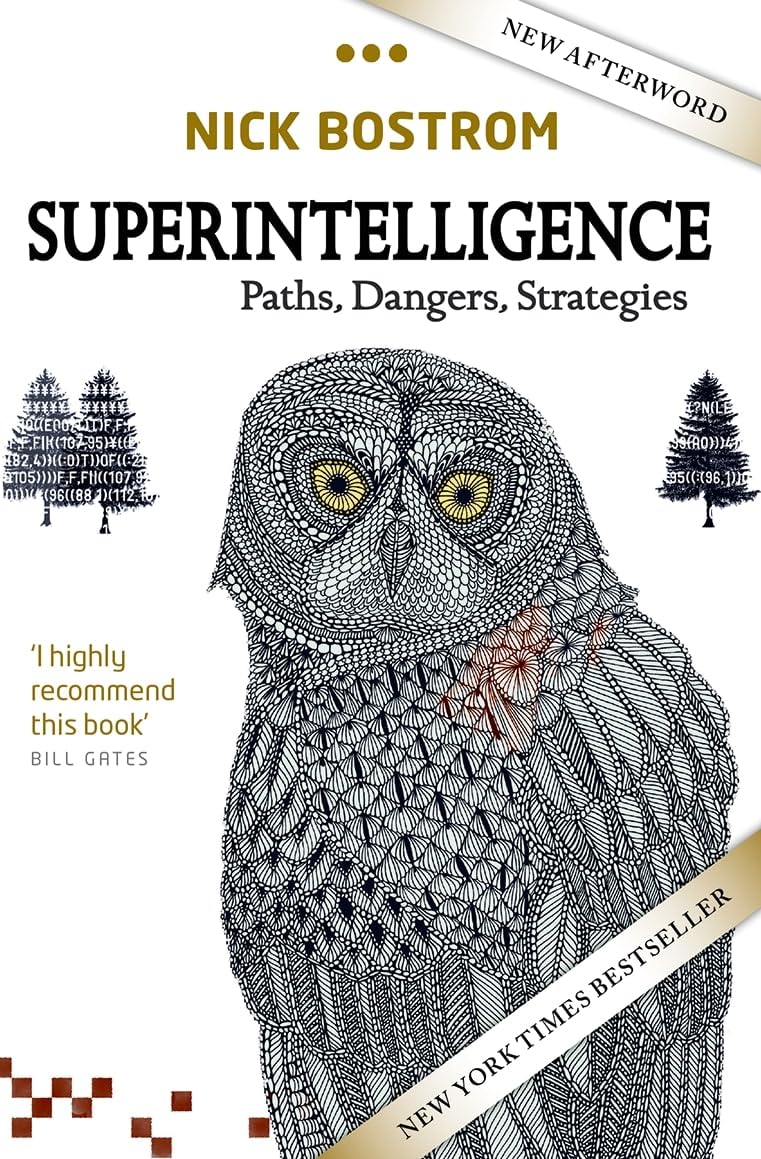
The book that started the existential-risk debate and that half the industry still cites.
As an Amazon Associate, Zendoric earns from qualifying purchases; the price does not change for you. · all our recommended books →
🔗 Related on Zendoric
- Sanders proposes banning superintelligence with prison for executives: the question the industry avoids · 2026-09-08
- Sanders wants 20 years in prison for building superintelligence — but nobody can define the crime · 2026-09-23
- Sanders would jail superintelligence builders for 20 years. The licensing agency, not the prison term, is the idea worth debating · 2026-09-24