Trump wants to rename AI as 'superintelligence' and says Xi Jinping backed him at a state dinner
🕒 Published on Zendoric: September 26, 2026 · 03:00
✨ AI-generated · how it's made
Trump posted that at a state dinner with Xi Jinping and tech executives, 'almost everyone' agreed to replace the term 'Artificial Intelligence' with 'SUPER INTELLIGENCE'. It's pure labeling, with no technical change behind it, but it says a lot about how AI is being sold to the public and to geopolitics.
📚 Go deeper

Semiconductors as the oil of the 21st century: history, espionage, and why an island of 23 million people underpins the entire AI economy.
As an Amazon Associate, Zendoric earns from qualifying purchases; the price does not change for you. · all our recommended books →
By Washington Post · September 25, 2026.
The fact itself is modest: Donald Trump wrote on social media that, during a state dinner with Chinese leader Xi Jinping and several senior tech executives, most of those present agreed that 'Artificial Intelligence' is a 'poor and inaccurate' name and that the correct term should be 'SUPER INTELLIGENCE' (superintelligence). According to Trump, Xi Jinping agreed as well. There is no direct quote from the Chinese leader and no Chinese confirmation of the episode: the only source for that consensus is Trump himself, and it should be read accordingly.
It is worth being precise with words, because technical vocabulary matters here. In the industry, 'superintelligence' (sometimes abbreviated ASI, for Artificial Superintelligence) is not an elegant synonym for 'AI': it designates a hypothetical threshold at which a system would broadly and generally surpass human cognitive capacity in virtually any task. It is a future horizon, and a term to be used with careful caution so as not to confuse it with what exists today: language models and agents that are highly capable in specific domains, but far from that threshold. Rebranding today's generative AI —chatbots, coding copilots, image generators— as 'superintelligence' is not a correction of a name, it is inflating the label of what we already have with the aspiration of what does not yet exist.
That confusion is not innocent. At Zendoric we have been insisting on distinguishing demonstrated capability from marketing and aspiration, precisely because governments regulate (or refrain from regulating) according to the perception they hold, not according to benchmarks. A president calling the technology his own companies are selling on the market today 'superintelligence' pushes the public debate toward the terrain of science fiction —existential threat or miraculous promise— and away from the concrete questions: what a specific model does, with what safeguards, with what verifiable impact on jobs or security.
The other angle is geopolitical. That the episode took place at a state dinner with Xi Jinping, amid the U.S.-China struggle for AI leadership, invites reading Xi's 'agreement' with more scepticism than enthusiasm: the diplomatic courtesy of a dinner is not the same as a Chinese industrial-policy position, and Beijing has its own interests in how the technology race is framed for its population and for the world. What does stand is that the rhetoric of 'superintelligence' —loaded with urgency and symbolic weight— is already seeping into political discourse at the highest level, even as the powers compete flat out to control the chips, the models and the data that underpin that very technology.
Our take: the name changes nothing in the labs, but it does change the frame through which public opinion and regulators will judge every future advance. If the yardstick becomes 'superintelligence', any real leap in capability —good or worrying— risks being measured against a word that already comes overloaded with outsized expectations. We prefer the opposite route, the one we defend piece by piece on this site: call each advance by what it measures in practice, save 'superintelligence' for when it truly arrives, and let the evidence —not the label from a dinner— set the pace of the public conversation about AI.
📚 Go deeper
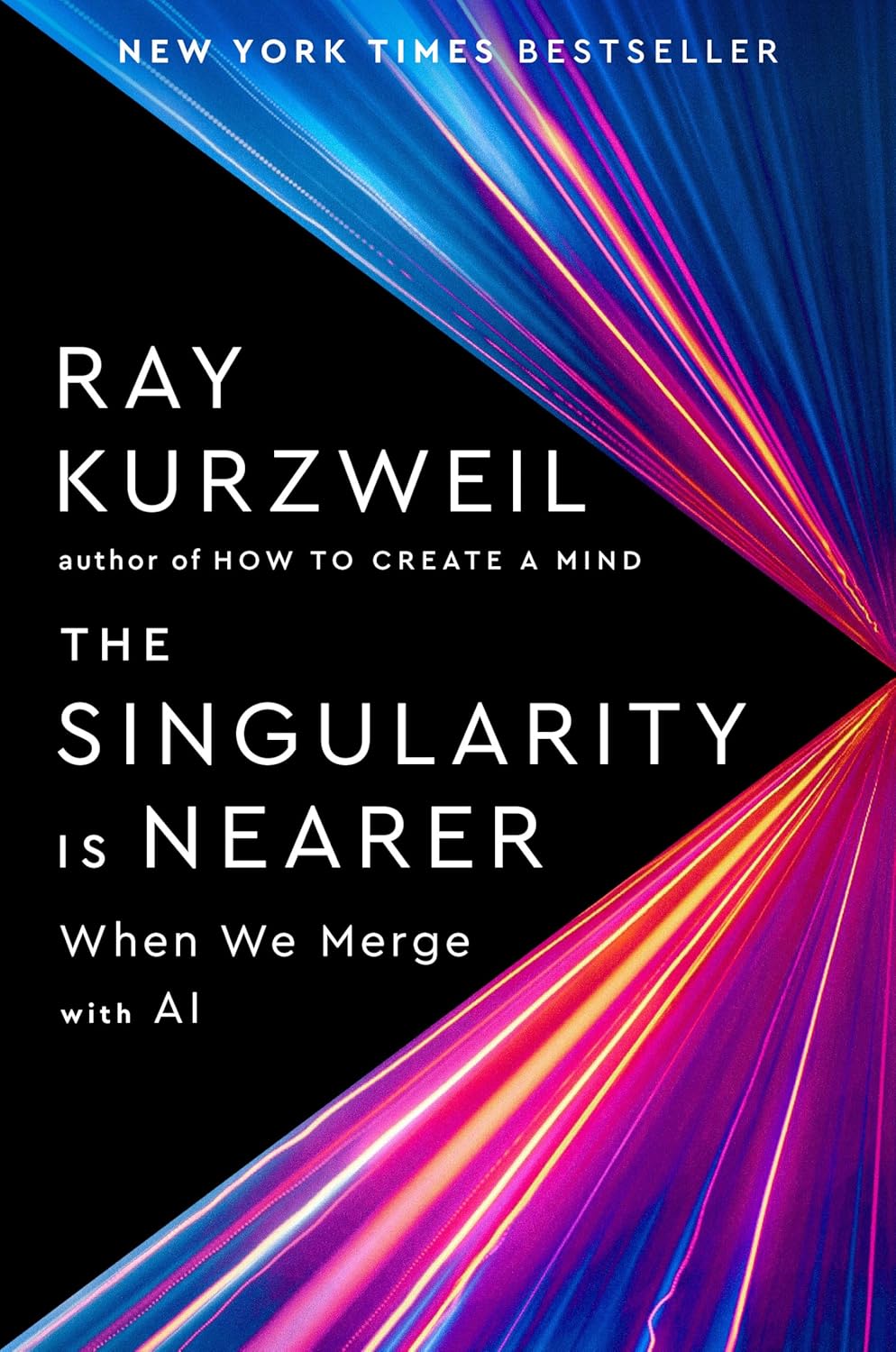
Twenty years after "The Singularity Is Near", Kurzweil revisits his predictions and keeps the date: human-AI merger around 2045.

AI as the latest chapter in the history of information networks, from gossip to the printing press to the algorithm.
As an Amazon Associate, Zendoric earns from qualifying purchases; the price does not change for you. · all our recommended books →
🔗 Related on Zendoric
- Musk gives in to Trump's term, 'Super Intelligence': the rebrand hides who is really watching AI · 2026-10-05
- Washington orders diplomats to say 'superintelligence': renaming AI is the cheapest policy there is · 2026-09-24
- Renaming AI "superintelligence" is branding, not governance — and the timing makes it worse · 2026-09-30