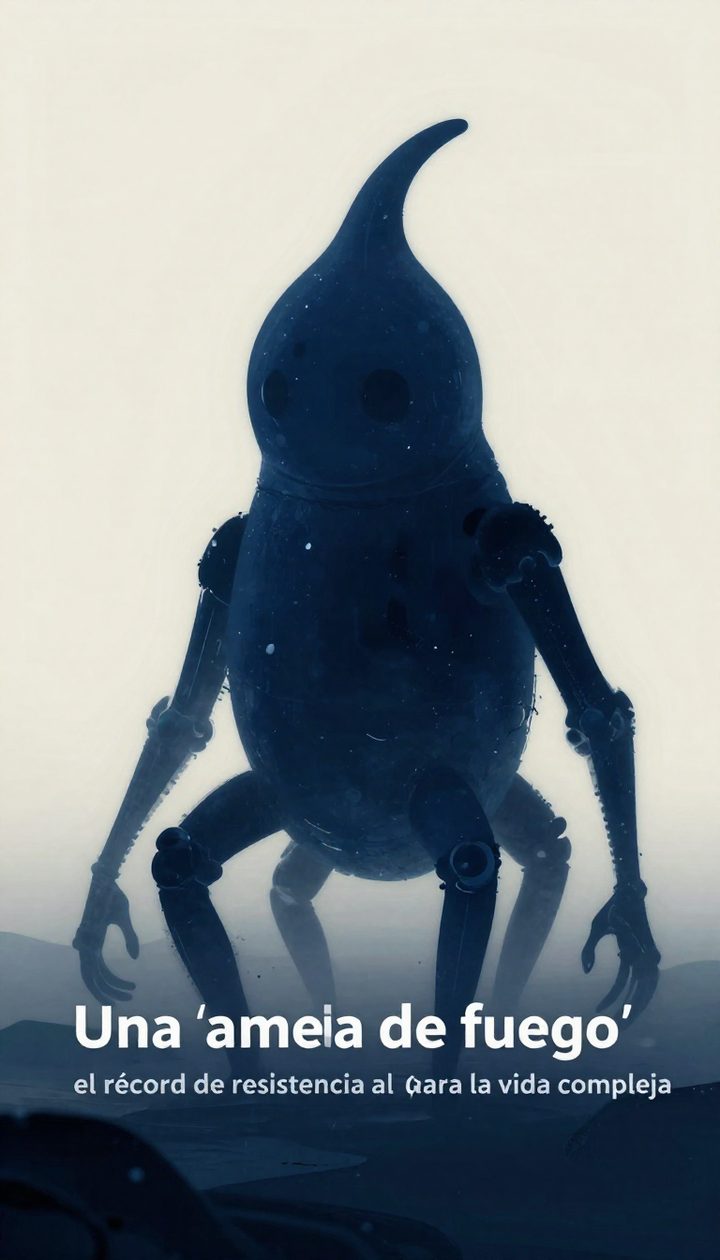
A 'fire amoeba' breaks the heat-tolerance record for complex life
🕒 Published on Zendoric: September 24, 2026 · 00:26
✨ AI-generated · how it's made
A team of researchers has described a new species of amoeba capable of withstanding temperatures never before recorded for a eukaryotic organism —that is, for any form of complex life made up of cells with a nucleus (the group that includes humans, among others).
📚 Go deeper

The memoir of the creator of ImageNet, the scientist who made the deep learning revolution in vision possible.
As an Amazon Associate, Zendoric earns from qualifying purchases; the price does not change for you. · all our recommended books →
A team of researchers has described a new species of amoeba capable of withstanding temperatures never before recorded for a eukaryotic organism — that is, for any complex life form made up of cells with a nucleus (the group to which humans, among others, belong). Named Incendiamoeba cascadensis — "fire amoeba of the Cascade range" — and informally nicknamed "fire amoeba," this single-celled creature can reproduce at temperatures of up to 145°F (about 63°C), keep moving up to 147°F (close to 64°C) and protect itself in waters of up to 158°F (around 70°C). The finding, published in the journal Cell, marks an advance of some five degrees over the previously known limit for complex cells.
The research is led by Angela Oliverio, a microbiologist at Syracuse University, and Beryl Rappaport, a doctoral student in her lab. Both study so-called extremophiles, organisms that thrive in extreme environmental conditions. Until now, the heat-resistance records were held by far simpler organisms, such as bacteria and archaea, some of which survive at temperatures of 212°F (100°C, the boiling point of water) or higher. According to Rappaport, the reason eukaryotes had not shown similar capabilities may simply be that the right organism had not yet been found and described, since very few species of this type have been studied in detail.
Oliverio compares the significance of the finding to the four-minute mile: for a long time it was considered an impossible barrier for the human body, until one athlete broke it and, weeks later, others replicated the feat. For the researcher, what matters about this discovery is not so much the exact margin of degrees gained but the proof that this thermal limit for complex life can be surpassed, which opens the door for other scientists to look for and find organisms with equally or even more extreme capabilities.
The discovery took place in Lassen Volcanic National Park, in northern California, one of the least-visited parks in the United States, in an area dotted with small steaming geothermal pockets. The team collected water samples from a tributary of Hot Springs Creek using extra-long barbecue tongs to submerge the vials without getting burned. Back in the lab, Rappaport examined the samples under the microscope and, after filming and speeding up the video, spotted an organism that stretched, retracted and changed shape fluidly, a movement characteristic of amoebae. On sequencing its genome, the team confirmed it was a species new to science.
Comparing the fire amoeba's genome with that of other amoebae, the researchers identified mechanisms that allow it to keep its proteins and cell membranes stable despite the extreme heat. Findings of this kind, Oliverio notes, not only help redefine the known limits of life on Earth but are also relevant to astrobiology, as they widen the range of conditions under which life might be sought elsewhere in the universe. She also points to possible practical applications, such as developing more heat-resistant crops or drugs that remain stable across wider temperature ranges.
Debashish Bhattacharya, an evolutionary biologist at Rutgers University who did not take part in the study, cautions that turning an exotic, extreme organism into something with a real and meaningful application for other species is, in his own experience, a complicated process, though he acknowledges there is always the potential to find something truly significant. Bhattacharya also highlights a striking genomic detail: while other extremophiles tend to show "genome streamlining" (a compaction of their genome that lets them compete with smaller-genome bacteria in hostile environments), the fire amoeba has gone the opposite way, with a larger genome than its close relatives, which he considers a particularly interesting finding.
Oliverio is convinced this discovery is only the beginning: she expects more scientists to set out in search of other complex organisms with similarly extreme thermal abilities, and she does not rule out that the record just set by the fire amoeba will be broken again soon.
📚 Go deeper

AI as an extractive industry: the lithium, the energy, the underpaid data-labeling work and the bodies behind the cloud.

The only novel on the list, by a Nobel laureate: an artificial friend observes humans with a blend of lucidity and innocence no essay achieves.
As an Amazon Associate, Zendoric earns from qualifying purchases; the price does not change for you. · all our recommended books →
🔗 Related on Zendoric