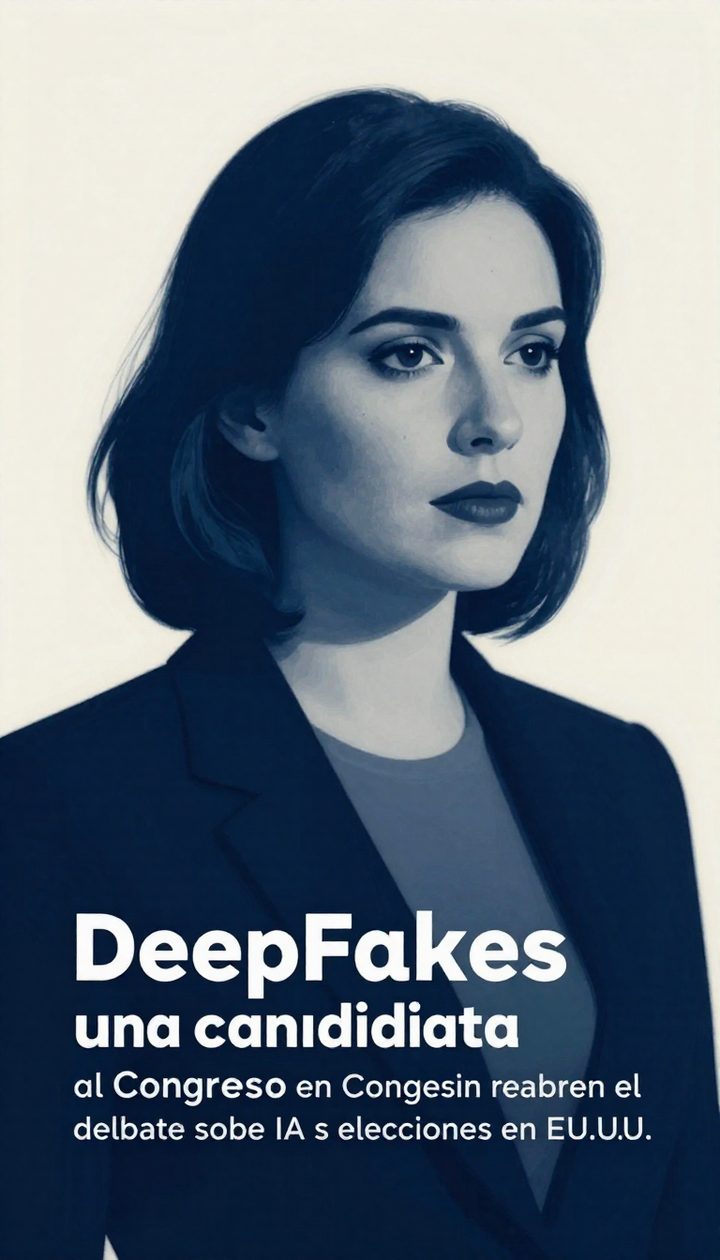
Deepfakes of a congressional candidate in Wisconsin reopen the debate on AI and elections in the US
🕒 Published on Zendoric: September 9, 2026 · 00:20
✨ AI-generated · how it's made
A Wisconsin television station reports the circulation of deepfake videos showing Rebecca Cooke, the Democratic contender for the 3rd Congressional District against Republican Derek Van Orden. The case, with few public details so far, once again raises a problem that is no longer hypothetical: synthetic disinformation in campaigns.
📚 Go deeper

How opaque algorithms decide who gets credit, a job or parole — and why they tend to punish the same people.
As an Amazon Associate, Zendoric earns from qualifying purchases; the price does not change for you. · all our recommended books →
By Zendoric · September 9, 2026.
WSAW, the Wausau, Wisconsin, station, has reported the existence of AI-manipulated videos depicting Rebecca Cooke, the candidate running against Representative Van Orden for the state's 3rd Congressional District seat. The report itself, distributed as a video piece, is brief: it does not detail who produced the material, what exactly the videos showed, when they began circulating or what response has come from Cooke's campaign or election authorities. We have to be honest about that: there is no basis for reconstructing the case beyond that single fact, and any attribution of authorship or intent would be speculation.
What is an established fact is the framework in which it occurs. Van Orden and Cooke already contested that same seat in 2024, in one of the closest races in the country, and the appearance of synthetic content on the eve of another electoral contest is not an isolated phenomenon: it fits a trend we have been documenting for months, in which increasingly accessible video and image generation tools lower the cost of fabricating false, credible material about specific candidates.
As sector context, this type of episode has become recurrent in recent election cycles in the United States and other countries: cloned audio of politicians' voices, generated images of events that never happened, videos attributing false statements to a candidate in the hours or days before a vote, when there is least time to debunk them. Production speed has clearly outpaced verification speed.
Our reading is that the underlying problem is not so much the technical sophistication of the deepfake —which is already high and keeps improving— but the institutional lag: electoral laws, platform codes of conduct and detection capacity that have not evolved at the same pace as generative tools. It is exactly the kind of short-term friction we had been anticipating: generative AI democratizes the creation of persuasive content, and in the electoral arena that democratization has an immediate dark side, while the mechanisms to curb it —fast verification, labeling of synthetic content, deterrent penalties— remain under construction.
It does not change our underlying thesis about the long term: the same AI systems that today make fabricating fake video easier are, in parallel, the basis for increasingly capable forensic detection tools, and social and regulatory pressure over cases like this tends to accelerate the adoption of content authenticity standards. But the gap between those two curves —creating deception and detecting or legislating it— is the terrain where the real contest is being fought in this election cycle, and cases like Wisconsin's, however scarce the public information still is, are evidence that this terrain is already in play, not up for theoretical debate.
📚 Go deeper

Algorithms in justice, medicine, cars and art, explained with British humor and mathematical honesty.

DeepMind co-founder on the dilemma of containing technologies that do not want to be contained.
As an Amazon Associate, Zendoric earns from qualifying purchases; the price does not change for you. · all our recommended books →
🔗 Related on Zendoric
- An Indian lawmaker reports a voice deepfake showing him talking about 'commissions': AI political disinformation reaches Maharashtra · 2026-06-29
- Piyush Goyal reports a deepfake of himself in India: the fraud is cheaper than the rebuttal · 2026-07-27
- An AI duck video sums up the problem: Van Orden mocks deepfakes after rival's legal ultimatum · 2026-10-02