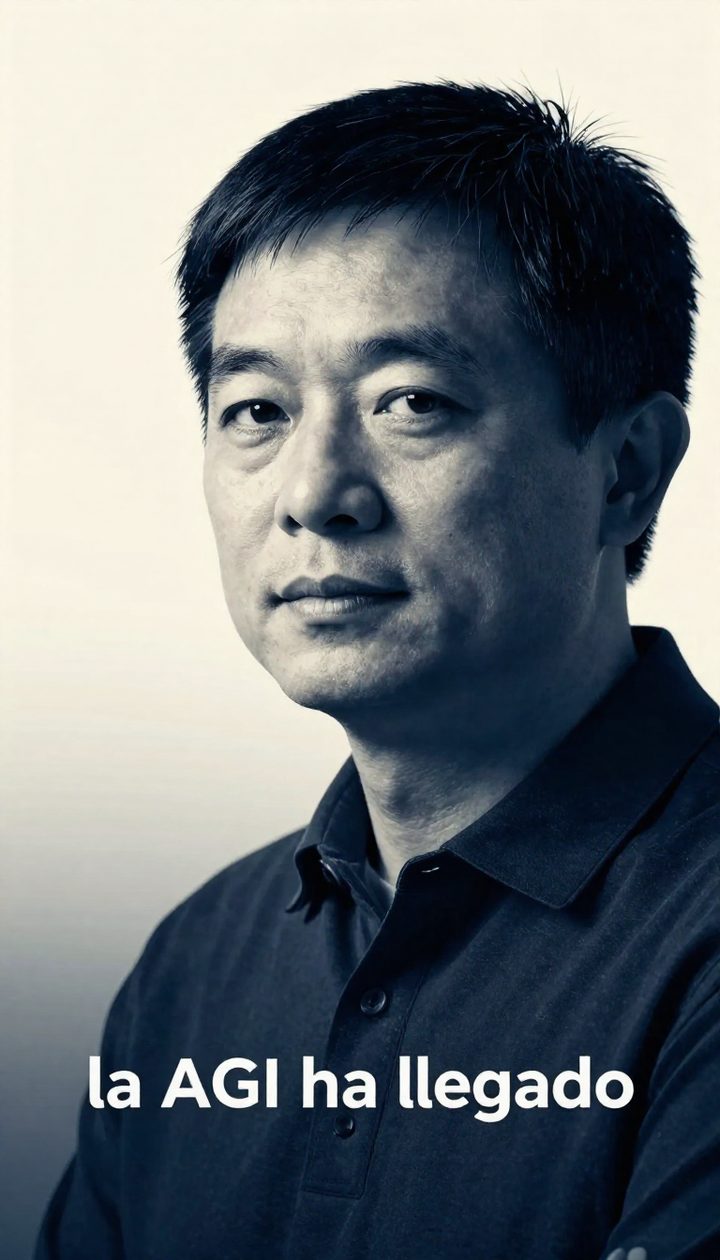
Jensen Huang declares "AGI has arrived" after the launch of Astra, OpenAI's new model
🕒 Published on Zendoric: September 9, 2026 · 00:20
✨ AI-generated · how it's made
Nvidia CEO Jensen Huang posted a message on X on Sunday congratulating the OpenAI team on the launch of Astra, its most recent model and, according to the company itself, its most powerful to date.
📚 Go deeper

The only novel on the list, by a Nobel laureate: an artificial friend observes humans with a blend of lucidity and innocence no essay achieves.
As an Amazon Associate, Zendoric earns from qualifying purchases; the price does not change for you. · all our recommended books →
Nvidia CEO Jensen Huang posted a message on X on Sunday congratulating the OpenAI team on the launch of Astra, its latest model and, according to the company itself, its most powerful to date. In the same message, Huang stated that "AGI is here," referring to artificial general intelligence, a term that usually describes systems capable of matching or surpassing human intelligence. Huang also drew a striking timeline: "From ChatGPT to o1 to Astra in four years," while noting in passing that Astra was trained on Nvidia chips.
OpenAI unveiled Astra the previous Thursday, describing it as the company's "smartest and most aligned" model, capable of performing "the most demanding professional work with unmatched speed, accuracy and judgment." Greg Brockman, OpenAI's president, reinforced the message on a call with reporters that same Thursday when he declared "welcome to the AGI era," adding that, in his view, the future will remember this moment and this model as the point at which artificial general intelligence was reached. "Personally, I think we're already there," he said. OpenAI defines AGI as "highly autonomous systems that outperform humans at most economically valuable work," and presented Astra as a major research advance and a shift in what can be delegated to AI. The model began rolling out to the company's customers that same week.
This is not the first time Huang has made a statement of this kind. In March, when podcaster Lex Fridman put to him a definition of AGI as a system capable of founding, growing and running a technology company valued at more than $1 billion, Huang replied: "I think it's now. I think we've achieved AGI." Other prominent figures in the sector have made similar claims about AI milestones: Elon Musk asserted in January that humanity had "entered the technological singularity," a point of no return at which AI accelerates beyond human intelligence; and in May, Marc Andreessen, co-founder of the investment firm a16z, argued that the AGI threshold had been crossed some three months earlier, contending that several frontier models were already "as smart as a person."
Not everyone shares this diagnosis, however. AI researcher and critic Gary Marcus wrote on his Substack on Sunday night that Huang had gotten ahead of himself with his comments about OpenAI achieving AGI: "Huang gave no evidence and no definitions, which strikes me as an attempt to appropriate a scientific question by corporate fiat. Declaring victory without a definition simply muddies the waters." Marcus attached his own ten-point definition of AGI and noted that Astra meets only one or two of those criteria, concluding that, by conventional definitions, Astra "still falls short." Along the same cautious lines, the researchers behind ARC Prize —the benchmark OpenAI itself highlighted when announcing Astra— stopped short of calling the model AGI. They described its results as an important advance, but warned that passing that test is not proof of AGI, since their tests take place in tightly bounded environments that do not reflect the complexity and open-ended nature of the real world. Sam Altman himself, asked about it in a recent appearance on the podcast "Sources," went so far as to call AGI "a term that is, at best, very poorly defined... I was going to say it's an irrelevant marketing term."
The article also points to the practical ambiguity of what reaching AGI would mean for everyday life: it could translate into breakthroughs in medicine and science, or into highly capable personal assistants for everyone, but it could also intensify pressure on employment.
Alongside the AGI rhetoric, the text turns the spotlight on the commercial backdrop to these statements. Frontier AI companies such as OpenAI, Meta, Anthropic and Google depend increasingly on the advanced chips made by Nvidia; in a funding announcement in March, OpenAI went as far as to describe Nvidia as "the foundation of our infrastructure," specifying that its training fleet and most of its inference stack still run on Nvidia GPUs. That demand has translated into very high business figures for the chipmaker: in August, Nvidia reported $96.2 billion in quarterly revenue, more than double the figure recorded in the same period a year earlier, of which $89 billion came from its data center division, which includes its AI chips. In his Sunday post, Huang suggested that available computing capacity will keep growing, announcing that "400,000 GPUs are about to come online."
Taken together, the statements illustrate a recurring dynamic in the sector: those who benefit most financially from the AI boom —whether as a chip supplier or as a lab that needs to justify multibillion-dollar funding rounds— are also the ones most enthusiastically proclaiming that historic thresholds such as AGI have been crossed, while independent researchers and specialized benchmarks call for more rigorous definitions before accepting that label. The lack of an agreed definition of AGI, acknowledged even by OpenAI's own CEO, leaves open the question of whether these statements reflect a verifiable technical leap or, above all, a narrative useful for sustaining investment momentum around AI infrastructure.
📚 Go deeper

An MIT computer scientist connects AI, quantum physics and video games to take an uncomfortable question seriously: what if we live in a simulation? M

The definitive piece of investigative journalism on OpenAI: 260+ interviews, the clash between safety and speed, and the attempted firing of Sam Altma
As an Amazon Associate, Zendoric earns from qualifying purchases; the price does not change for you. · all our recommended books →
🔗 Related on Zendoric
- Huang declares the AGI era with GPT-6 Astra: the one selling the chips is not a neutral referee · 2026-09-08
- Nvidia's Huang declares "AGI has arrived" — note who is declaring it, and on what evidence · 2026-09-08
- OpenAI unveils GPT-6 Astra and Nvidia certifies the 'AGI era': the problem is that nobody agrees on what that means · 2026-09-09