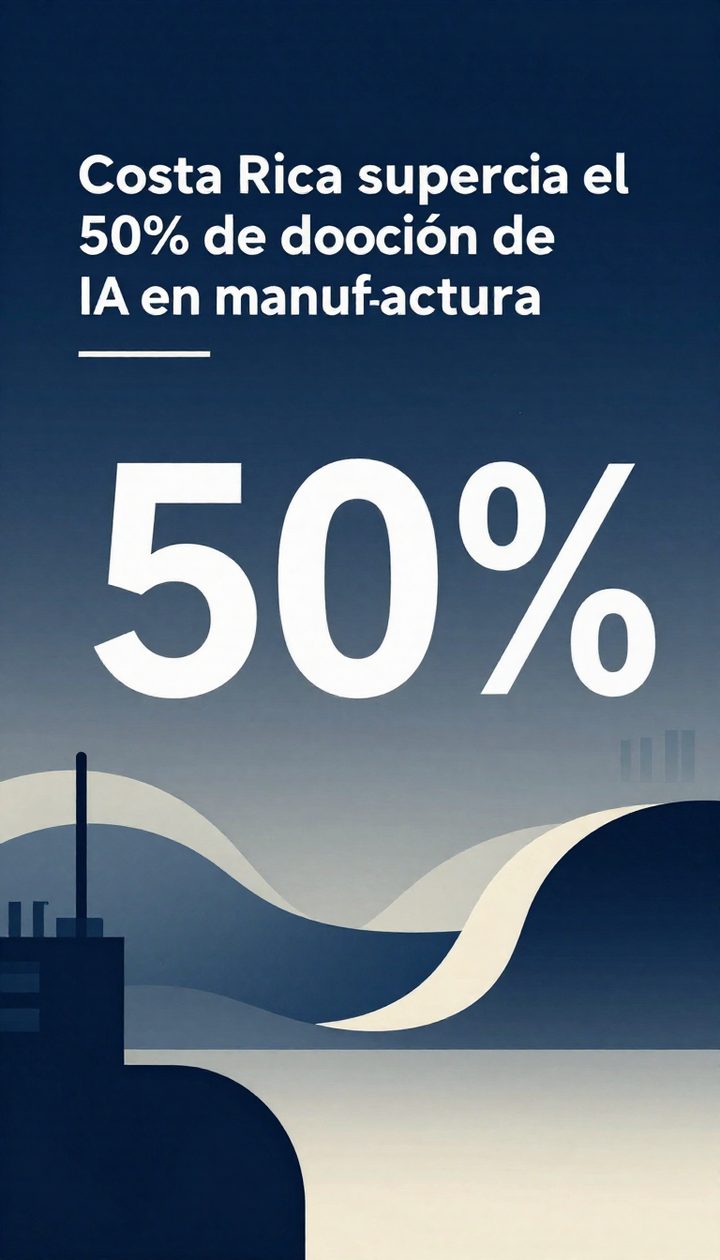
Costa Rica tops 50% AI adoption in manufacturing, but the wave has yet to reach the factory floor
🕒 Published on Zendoric: September 8, 2026 · 00:18
✨ AI-generated · how it's made
53% of Costa Rican manufacturing already uses AI, according to the Chamber of Industries, but almost all of that adoption is in the office — administration, marketing, sales — not on the factory floor. That is why 95.1% did not touch their headcount. The gap between free trade zones (71.4%) and local SMEs (47.1%) will shape the next chapter.
📚 Go deeper

The best starting book if you're not technical: a Wharton professor explains how to work WITH AI — when to delegate, when to supervise, when to keep i
As an Amazon Associate, Zendoric earns from qualifying purchases; the price does not change for you. · all our recommended books →
By Zendoric · September 8, 2026.
Costa Rica has just crossed a symbolic barrier: 53% of its manufacturing companies already use artificial intelligence in some process, according to a survey by the Cámara de Industrias de Costa Rica conducted between April 9 and July 15, 2026, with a 95% confidence level and a 3.1% margin of error per stratum. It is one of the first times a Latin American country has documented with a formal survey that the majority of its industry already works with AI day to day.
The average hides an underlying gap. In the free trade zones —the regime that groups multinationals and exporters with tax benefits, and which in Costa Rica concentrates much of the medical device and electronic component manufacturing— adoption reaches 71.4%. In the definitive regime, where mostly locally owned SMEs operate, the figure falls to 47.1%. Almost 25 points of difference between the Costa Rica that exports to the world and the one that sells at home.
Where AI is being used helps to understand the picture: according to the survey, above all in administration, management, marketing, sales and innovation, and still very little in production or direct service processes. It is office AI, not plant AI. Free-zone multinationals have more budget, more pressure from headquarters and more enterprise software vendors knocking at the door; local SMEs do not.
That nuance explains the figure that grabs the most headlines: 95.1% of the companies that adopted AI reported that their workforce did not change. Only 1.6% cut staff and another 1.6% increased it, with no relevant differences by regime or company size. It is a result consistent —not a Costa Rican coincidence— with what we have been observing in other sectors in this series: the first wave of adoption comes in through the back office (billing, reporting, campaigns, customer service) and takes far longer to reach the shop floor, where changing a process means touching machines, industrial safety and certifications, not just a workflow on a screen.
A warning is in order here that the survey itself does not make: the fact that employment has not moved yet does not mean the picture is final. It is a snapshot of one specific phase of adoption, the easiest and cheapest to implement. The question that really matters for 2027-2028 is not whether AI is in the Costa Rican factory, but when it migrates from the office to the production line, and what happens to employment when it does.
Costa Rica is not an isolated case; it is the visible tip of an infrastructure being assembled across the region. In August 2026, Epicor announced the general availability of Epicor Prism in Latin America, a portfolio of vertical AI agents for manufacturing and distribution integrated directly into its ERP —the software that manages a company's entire operation— Kinetic and Prophet 21, as Yahoo Finance reported; Epicor itself describes it as the leap toward a "Cognitive ERP" that moves from recording operations to deciding about them. In June, SORBA.ai signed an alliance with ECN Automation to bring its no-code industrial AI platform to the United States and Latin America, and in July it closed a similar agreement with Dautom in Colombia for predictive maintenance and anomaly detection in manufacturing, food and energy, according to the respective press releases. None of these moves point to pilots: they point to industrial AI becoming factory infrastructure, as the ERP itself once was.
The economic backdrop helps explain why Costa Rica is fertile ground for that infrastructure. In September, PROCOMER brought together more than 1,000 exporting companies and delegations from more than 40 countries at the Costa Rica Trade & Investment Summit, as Bolsamania reported. Services account for 34% of the country's exportable offering, medical devices 31% and agriculture 11%; more than 1,000 companies with foreign direct investment generate 312,000 jobs, and exports from January to July 2026 totaled USD 13.821 billion, 5% more than in the same period of 2025. It is an economy already oriented toward high value-added manufacturing —medical devices above all— the type of industry where AI applied to quality control, predictive maintenance and design can add productivity without necessarily subtracting jobs on net.
Our reading is that this Costa Rican figure is genuinely good news, not cosmetic, but limited in scope over time. In the short term it confirms something we have been observing sector by sector: the narrative that "AI destroys jobs massively and right now" does not hold up in manufacturing, at least in this phase, because vertical AI software today competes with spreadsheets, not with the woman working the assembly line. That is not permanent consolation: it is a window of time —probably two or three years— in which companies and government could prepare for the next stage, the shop floor one, instead of denying it.
The other reading, a more uncomfortable one, is the gap between the free trade zone and the definitive regime. If the exporting multinational automates its administration faster than the local SME, inequality does not show up first in aggregate employment, but in relative productivity: the exporting company cuts costs and gains margin while the local SME competes under the same rules with fewer tools. That internal imbalance —more than the generic fear that "AI will take away jobs"— is the short-term risk a country like Costa Rica should watch, and probably the strongest argument for public policy on AI adoption not to be limited to the free trade zones.
In the long term, it remains the underlying thesis we defend at Zendoric: manufacturing that uses AI for predictive maintenance, quality control and design —applied, for example, to the manufacture of medical devices, one of Costa Rica's export pillars— is not just a story about efficiency. It is the kind of automation that makes health technology cheaper to produce and pushes in the direction of the health abundance we consider the real horizon of this technology. The challenge, meanwhile, is for that transition not to leave behind the SME that today adopts AI at half the speed of the multinational next door.
It is also worth reading the survey itself with the rigor it deserves: it was conducted by a business association, the Cámara de Industrias, with a legitimate interest in showing a modern and competitive industry, and its 3.1% margin of error per stratum is reasonable but does not eliminate the bias of who answers this kind of poll. It is a good first data point, not the last word on the impact of AI on Latin American manufacturing.
📚 Go deeper

How opaque algorithms decide who gets credit, a job or parole — and why they tend to punish the same people.

The reference manual for building products on top of AI models: prompts, RAG, fine-tuning, agents, evaluation and deployment.
As an Amazon Associate, Zendoric earns from qualifying purchases; the price does not change for you. · all our recommended books →
🔗 Related on Zendoric
- The U.S. legislates AI literacy in the classroom while cutting the office meant to enforce it · 2026-07-26
- When the State asks for a pause: the era of staggered AI launches begins to take shape · 2026-06-27
- The CEO under pressure, according to McKinsey: an analysis almost no one will be able to access · 2026-06-28