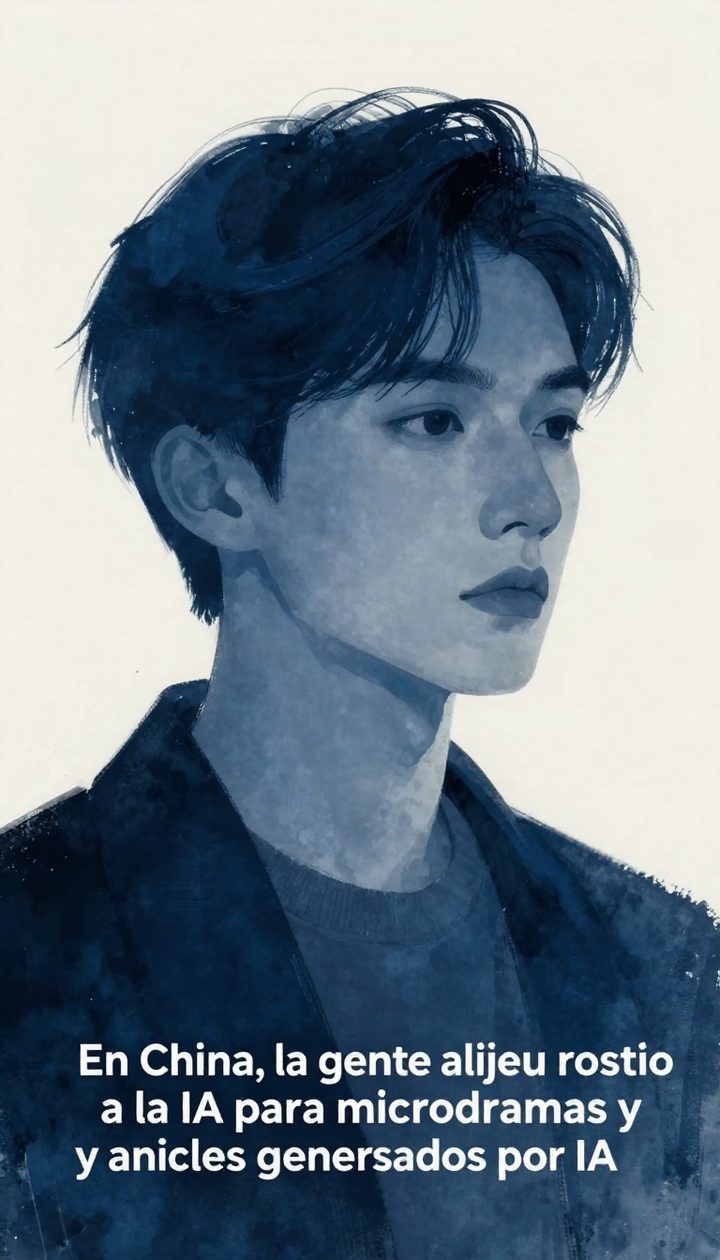
In China, people rent out their faces to AI for AI-generated microdramas and ads
🕒 Published on Zendoric: July 29, 2026 · 00:34
✨ AI-generated · how it's made
The artificial intelligence boom in China has given rise to an unprecedented market: platforms where people can rent or license their own face for use in AI-generated content.
📚 Go deeper
China vs.
As an Amazon Associate, Zendoric earns from qualifying purchases; the price does not change for you. · all our recommended books →
The rise of artificial intelligence in China has given rise to an unprecedented market: platforms where people can rent out or license their own face for use in AI-generated content. As reported by Rest of World, these platforms pay users between $15 and $700 to license their likeness, which is then used in ads, video games, TV commercials and, above all, in 'microdramas', the ultra-short vertical video series designed for mobile that make up a multibillion-dollar industry in the country.
It works much like a casting catalog: the platforms gather images uploaded by users themselves or shot at designated studios, and producers can filter candidates by gender, age or categories such as 'girl next door', 'weathered face' or 'supermodel', as well as by the project's narrative genre (thriller, comedy, romance). Users themselves choose what kinds of products or scenes their face can appear in and set the price based on the type of face, the permitted uses and the number of productions it can be used in.
The context that explains this market is the extremely rapid adoption of AI in Chinese audiovisual production: more than 95% of the 128,000 microdramas released in the country during the first quarter of 2026 used AI at some point in their production. Unlike the United States, where disputes over the unauthorized use of AI-generated faces have centered on celebrities (the cases of Tom Hanks and Scarlett Johansson are the most frequently cited), in China the problem mainly affects ordinary people who discover their own face starring in AI dramas they never consented to.
One example cited is Hongguo, the AI drama platform of ByteDance (the parent company of Douyin, the Chinese version of TikTok), which two influencers accused of stealing and altering their faces using AI without authorization; the minidrama in question, which had surpassed 40 million views, was taken down. ByteDance says it has removed more than 85,000 videos featuring unauthorized AI reproductions of faces and voices since the start of 2026.
Against that backdrop, intermediaries such as Shenzhen-based ActID have emerged, handling licensing agreements, monitoring the internet to detect unauthorized uses of registered faces and connecting users with lawyers if legal action becomes necessary. Since its launch in March 2026, ActID has registered some 800 users, of whom around 300 have agreed to license their likeness for AI productions; they include professional extras, influencers and people with no acting experience. So far, two AI drama productions have licensed around 10 faces through the platform, at prices between 99 and 500 yuan ($15 to $74) per episode, from which ActID takes a 10% commission. Its marketing director, Camille Yan, explains that producers look for attractive faces for lead roles but also distinctive ones, such as older people, since these dramas 'do not require any acting ability at all': the face serves only as source material.
Another platform, Chengdu-based New Claw, grew out of a business pivot by a traditional production company that watched AI upend its work. According to its head of operations, Long Lyu, since late last year traditional drama production has declined, advertising budgets have contracted and even luxury brands have begun opting for AI-generated productions, because licensing a face is cheaper than hiring a person to act. New Claw has set a minimum price of 500 yuan ($74) per image to keep users from undercutting one another.
The use of real faces is also being floated as a possible solution to another problem flagged by viewers on social media: the sense that many AI-generated characters look alike. In fact, Hongguo announced in July that it would crack down on dramas with overly homogeneous faces.
Not everyone sees these platforms as a risk-free solution. Xu Fang, a 21-year-old model from Shanghai who has filed a lawsuit against a Chinese fashion brand for using his face on products he never actually modeled, says he would never sell the rights to his own face: he fears being unable to control how AI might alter his image or portray him in degrading ways. The accelerated adoption of AI has driven a surge in litigation over the unauthorized use of people's likenesses: the Guangzhou Internet Court has heard some 700 cases related to AI face theft in the past three years, according to the outlet National Business Daily. In March, the Beijing Internet Court issued a ruling considered an important legal precedent — widely cited by Chinese state media — in a case involving an AI drama accused of using a celebrity's likeness without consent: the court determined that using a person's face in AI-generated 'face swaps' without authorization is illegal, even if the image has been modified.
Beijing lawyer Yile Deng, who specializes in AI-related image rights cases, considers the emergence of this business model for selling facial image rights a positive step toward a clearer commercial and legal framework, but warns that these platforms cannot eliminate the underlying risks: once a person's facial data enters an AI market, that person can lose long-term control over how their biometric identity is used, since platforms cannot prevent unauthorized face swapping, the illegal collection of data or its future use to train new AI models. According to Deng, the most obvious problem remains the unclear scope of authorizations: many agencies pay only a few dozen dollars for facial data, but contracts usually have licensing terms so vague that it is impossible to know who will ultimately use that image or for what purpose.
Skepticism also comes from within the AI drama industry itself. Director Wendi Ma explains that some productions have bought faces so their characters would not look 'too AI', but that most AI-generated minidramas still rely on entirely synthetic characters because, in the end, what weighs most is cost control.
📚 Go deeper
The best starting book if you're not technical: a Wharton professor explains how to work WITH AI — when to delegate, when to supervise, when to keep i

Semiconductors as the oil of the 21st century: history, espionage, and why an island of 23 million people underpins the entire AI economy.
As an Amazon Associate, Zendoric earns from qualifying purchases; the price does not change for you. · all our recommended books →
🔗 Related on Zendoric
- Saudi Arabia reaps six medals at the first Asia-Pacific AI Olympiad: a sign that a young-talent strategy is paying off · 2026-06-29
- Hartford bets on teaching AI to its young people before the job market leaves them behind · 2026-07-01
- Apple Intelligence gets regulatory approval in China thanks to Alibaba and Baidu · 2026-07-17