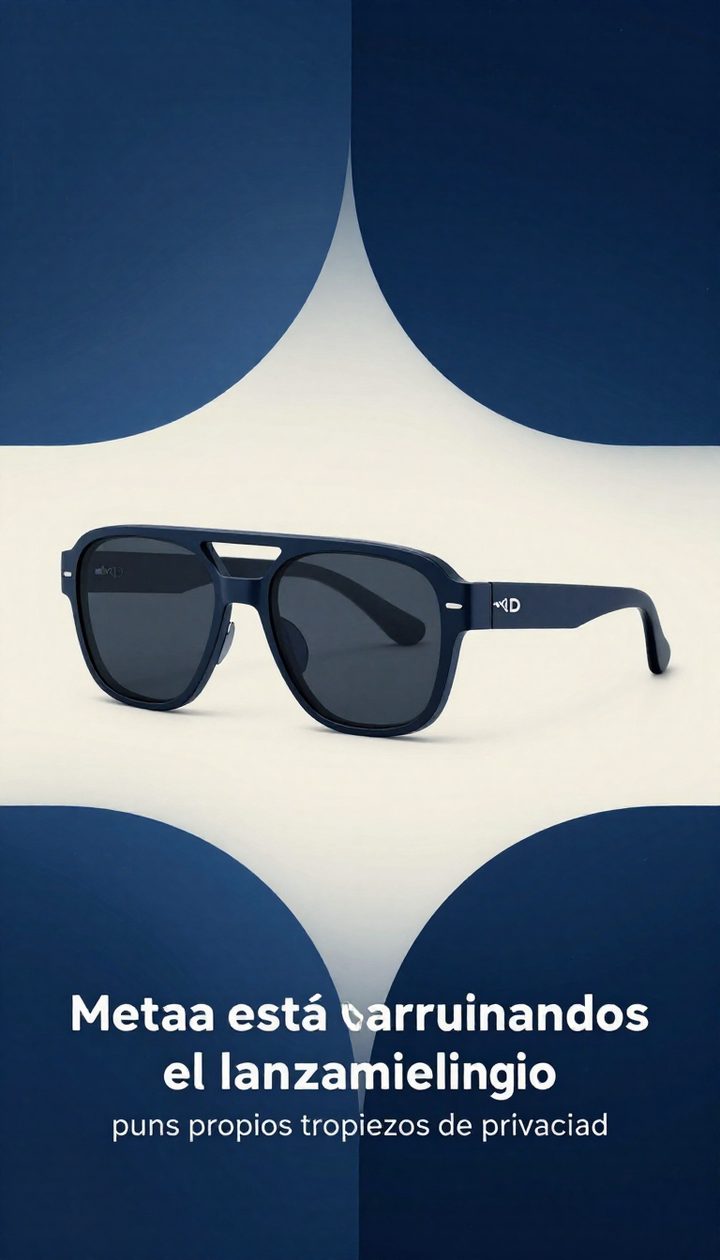
Meta is ruining the launch of its smart glasses through its own privacy missteps
🕒 Published on Zendoric: July 29, 2026 · 00:34
✨ AI-generated · how it's made
In cities such as New York, London and Washington D.C., activist groups have pasted satirical posters over ads for Meta's smart glasses, calling them "the biggest breakthrough in pervert technology since the trench coat" and accusing influencer Kylie Jenner, a brand ambassador, of lending her…
📚 Go deeper

The definitive piece of investigative journalism on OpenAI: 260+ interviews, the clash between safety and speed, and the attempted firing of Sam Altma
As an Amazon Associate, Zendoric earns from qualifying purchases; the price does not change for you. · all our recommended books →
In cities such as New York, London and Washington, D.C., activist groups have pasted satirical posters over ads for Meta's smart glasses, calling them "the biggest advance in pervert technology since the trench coat" and accusing influencer Kylie Jenner, a brand ambassador, of lending her image to "predatory mass surveillance glasses." The message of these guerrilla campaigns is clear: these devices can violate the privacy of third parties, and trust in Meta to prevent that is at rock bottom.
Meta's privacy strategy for its glasses has long relied almost exclusively on a small LED light indicating when recording is under way, combined with an informal "don't be a jerk" policy. The result, over the past three years, has been a wave of so-called "glassholes": users who record videos, often sexualized in nature, without the consent of the people being filmed, sometimes even disabling that light. Meta's vice president of wearables, Alex Himel, has acknowledged to The Verge that the company is aware that more and more users are tampering with the devices to get around that visual warning.
In response, Meta has announced a mandatory software update that will disable the camera on all its glasses if physical tampering with the privacy light is detected. In parallel, Instagram head Adam Mosseri has said the platform will take down videos recorded with Meta's glasses that show harassment. These are positive measures, the article notes, but they come late: Meta could have implemented them from the start, and Instagram's decision also raises new questions about content moderation.
The piece acknowledges that, in commercial terms, Meta has made the right calls to popularize smart glasses. Faced with an overly conspicuous Google Glass, the Ray-Ban Meta glasses bet on discretion and normality; Bose had already explored audio glasses and Snap got there first with the idea of recording first-person content for social media, but it was Meta, thanks to its partnership with EssilorLuxottica, that delivered an affordable product with a recognized brand and genuine style, making it the closest thing to a mass-market model. That same approach of partnering with fashion eyewear makers — Warby Parker and Gentle Monster — is now being replicated by Google and Samsung.
In recent months, however, Meta has reportedly strung together a series of decisions that erode that advantage. The article recalls a New York Times report according to which the company sought to deploy facial recognition technology in the glasses while privacy advocates were distracted by other matters. Added to that is a Wired report claiming Meta had already quietly integrated that facial recognition into the existing glasses, albeit without switching it on, and a Financial Times report holding that the company wants the glasses to record continuously, 24 hours a day. Beyond these major episodes, Meta also removed the option to opt out of having voice recordings used to train its artificial intelligence, and some of its executives have gone so far as to suggest that those who reject smart glasses will be left at a "cognitive disadvantage." All of this while the company continued handing out the device to content creators and launched a high-visibility campaign with Kylie Jenner, one of the most polarizing celebrities of the moment.
For Uttara Ananthakrishnan, a technology professor at the University of Washington who specializes in the effect of online interactions on platforms, markets and social behavior, resting an entire privacy policy on a single LED light is not enough: you cannot expect everyone to know what it means or to react to it, and that burden falls unfairly on the person who is not wearing the glasses. Ananthakrishnan is skeptical that smart glasses will succeed outside very specific workplace settings, not only because of the social stigma they still carry, but because society's attitude toward Big Tech has changed radically since the era of the first smartphones. Unlike back then, she says, there is now far more awareness that there are bad actors online capable of causing real harm, and that anything shared can have legal consequences.
The professor also distinguishes the privacy calculus of devices such as smartwatches — where the user takes on a risk that affects only themselves, in exchange for a clear personal benefit — from that of camera glasses, in which the wearer puts other people's privacy at risk, often without their consent, potentially becoming the agent of the harm rather than the victim.
Asked by The Verge, a Meta spokesperson, Maren Thomas, replied by email that the company is "committed to building privacy into every iteration of its glasses so that they are loved both by the people who wear them and by those around them." But that message does not convince critics. Kendall Schrohe, executive director of Attention Sphere — one of the activist organizations linked to the satirical posters in Washington, D.C., and New York — argues that there is little Meta can do to prove it genuinely cares about users' privacy when its business model is based precisely on invading it, and adds that sunglasses with a built-in camera are, by definition, surveillance technology, and no technical tweak changes that nature. Schrohe also recalls that Meta, along with other Big Tech companies, has lobbied to weaken state privacy laws, further undermining its credibility.
Ananthakrishnan agrees that "this moment has already passed" for Meta: the company does not have a reputation for communicating its privacy policies well, and neither it nor Google — perhaps only Apple — could make a reassuring privacy statement credible to the public in this context.
The article concludes that the current backlash against smart glasses combines social stigma toward these devices, general fatigue with Big Tech and, specifically, Meta's own reputation. Barring a drastic shift, changing that narrative will be difficult. And while it might be tempting for some industry executives to resign themselves to a kind of surveillance dystopia until lawmakers or private companies force them to correct course, the conclusion is that everyone is watching to see what card Meta plays next as the current leader of this category: if it sticks with the same strategy, it risks ceding leadership to Google or Apple, or sinking the smart glasses category as a whole.
📚 Go deeper

DeepMind co-founder on the dilemma of containing technologies that do not want to be contained.

How opaque algorithms decide who gets credit, a job or parole — and why they tend to punish the same people.
As an Amazon Associate, Zendoric earns from qualifying purchases; the price does not change for you. · all our recommended books →
🔗 Related on Zendoric
- Samsung says smart glasses privacy concerns require an industry-wide solution · 2026-07-24
- AI glasses in exams: when cheating beats the top 5 of the class, the assessment system has a bigger problem · 2026-06-28
- Cancer survivors in Washington launch an AI platform for oncology patients: the story, with few verifiable details · 2026-07-26