New Zealand launches an AI health coach in primary care: supporting the doctor, not replacing them
🕒 Published on Zendoric: July 27, 2026 · 00:21
✨ AI-generated · how it's made
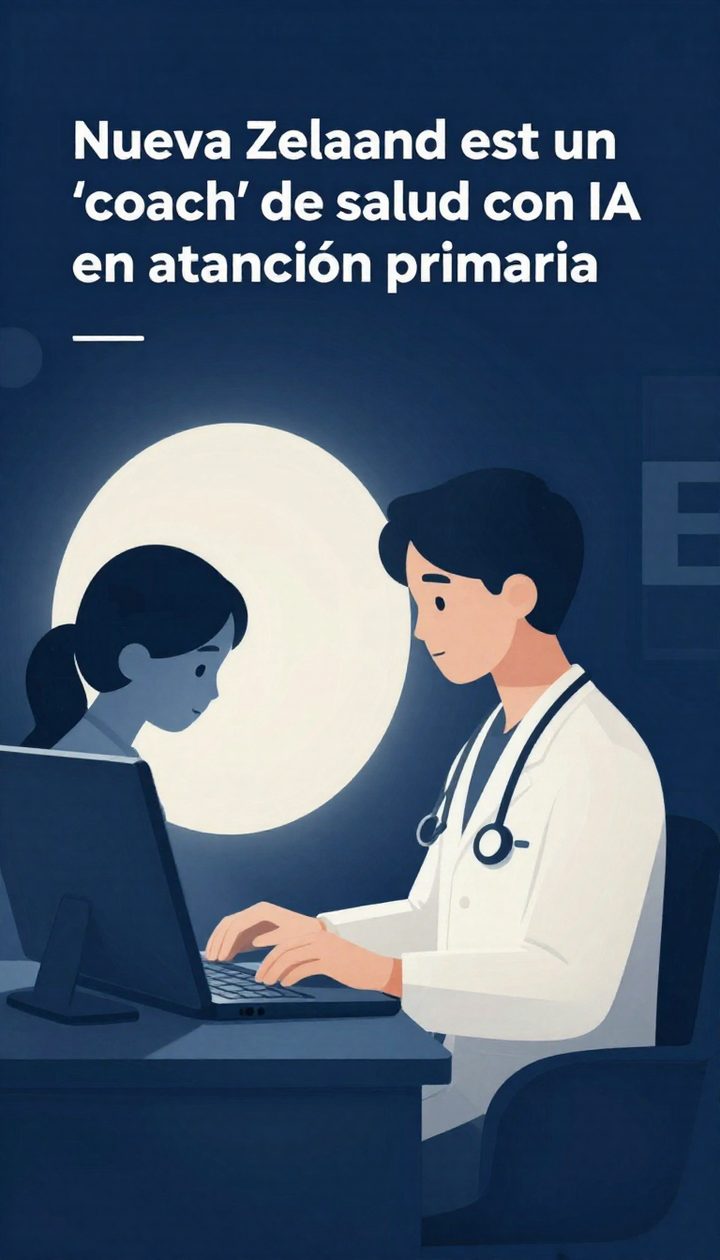
Tāmaki Health is rolling out New Zealand's first AI health coach in primary care. In a pilot involving 4,500 conversations, patients say they feel up to 75% more capable of managing their health after two months, according to the company itself.
📚 Go deeper
How opaque algorithms decide who gets credit, a job or parole — and why they tend to punish the same people.
As an Amazon Associate, Zendoric earns from qualifying purchases; the price does not change for you. · all our recommended books →
By Zendoric · July 27, 2026.
Tāmaki Health, one of New Zealand's largest private healthcare networks, has launched the country's first "AI Health Coach" (a health coach powered by artificial intelligence) integrated into primary care. The system, already being piloted at selected clinics, offers patients round-the-clock support conversations about habits and chronic conditions, even before they book an appointment with their doctor.
According to Tāmaki Health's own data, across more than 4,500 conversations logged during the pilot, users reported an average 32% increase in their confidence and ability to manage their health after a single session, a figure that rises to 75% after two months of use. Average reported satisfaction is 8.5 out of 10. These are self-perception data collected by the provider itself, not objective clinical outcomes (such as glycemic control or hospital readmissions), a distinction worth keeping in mind before treating them as conclusive.
The tool is built on Groov, the New Zealand digital health company that already operates Ask Groov, the first AI wellbeing assistant backed by Health New Zealand (the country's public health system), with more than 13,500 conversations logged since its launch, according to Groov itself. The new Health Coach inherits that clinical and security infrastructure: privacy impact assessments, security testing and ISO 27001 certification (the international standard for information security management), with defined referral pathways to the human team when it detects physical symptoms, psychological distress or a need for further support.
The design is explicitly hybrid, not a replacement. The system addresses conditions such as diabetes, gout, weight loss and anxiety through personalized action plans, but refers patients to Tāmaki Health's human Health Coaches and clinical teams as soon as it detects a need that goes beyond behavioral support. It is modeled on New Zealand's Integrated Primary Mental Health and Addiction (IPMHA) program, which already combined human coaching with clinical referral protocols.
One nuance is worth noting: Dr. David Codyre, clinical director of Tāmaki Health's wellbeing team and quoted in the announcement, is also a board member and a member of the clinical advisory group of Groov, the company supplying the technology. This does not detract from the project's validity, but it should be flagged as a structural link between client and supplier, something the pilot evaluation — promised by both organizations — should clear up with hard clinical data, not just self-reported confidence.
Broadly, this launch fits a wider trend: health systems in wealthy countries face shortages of primary care doctors and are looking to AI as a way to extend — not replace — scarce clinical time. The New Zealand case is interesting because it does not start from scratch: Tāmaki Health had spent years demonstrating that its human Health Coaches reduced unnecessary visits and improved chronic disease control; what AI does here is scale a model that has already been proven, not invent a new one.
That is precisely the reading that interests us. In our analysis of how AI is transforming healthcare employment, we have argued that therapy, long-term care and the clinical relationship are the roles most resistant to automation, while coordination and administrative follow-up tasks are the first to be digitized. This case confirms that from the positive side: the human Health Coach does not disappear, but their time is concentrated on the patients who genuinely need a person on the other end, while AI covers routine support — reminders, encouragement, habit tracking — that was previously out of reach for lack of human hours.
In the long term, this kind of intervention is exactly the terrain where we believe AI can move the needle toward better and more equitable health: diabetes, obesity and sedentary lifestyles are not cured with a new drug, but with sustained adherence to behavioral change, something that until now has been extremely expensive to offer at scale because it depended entirely on hours of a human professional's time. If a cheap AI coach available 24/7 can sustain that adherence — with safe referral when a human is needed — it opens a real path toward mass prevention of chronic disease, not just treatment of the disease that already exists. It is a small step, still without hard clinical evidence, but it points in the direction of the healthcare abundance we champion as this technology's horizon.
The announcement itself notes that the burden of chronic disease falls disproportionately on Māori and Pasifika communities in New Zealand, and presents expanded access as an opportunity for equity. It is a reasonable promise, but the material provides no efficacy data broken down by ethnicity, so it is a claim to watch rather than take for granted, until the joint evaluation promised by Tāmaki Health and Groov publishes concrete figures.
📚 Go deeper

The best starting book if you're not technical: a Wharton professor explains how to work WITH AI — when to delegate, when to supervise, when to keep i
The definitive piece of investigative journalism on OpenAI: 260+ interviews, the clash between safety and speed, and the attempted firing of Sam Altma
As an Amazon Associate, Zendoric earns from qualifying purchases; the price does not change for you. · all our recommended books →
🔗 Related on Zendoric
- OpenAI announces Astra, its most capable model at hacking systems, evaluated only by the company itself · 2026-09-02
- Anthropic, both accuser and accused: the complaint against Alibaba lands amid a regulatory storm · 2026-06-26
- Claude Science: Anthropic takes aim at the heart of science and health with a dedicated product · 2026-07-01