Samsung puts AI into every step of back-to-school: from the classroom to the home fridge
🕒 Published on Zendoric: July 22, 2026 · 01:59
✨ AI-generated · how it's made
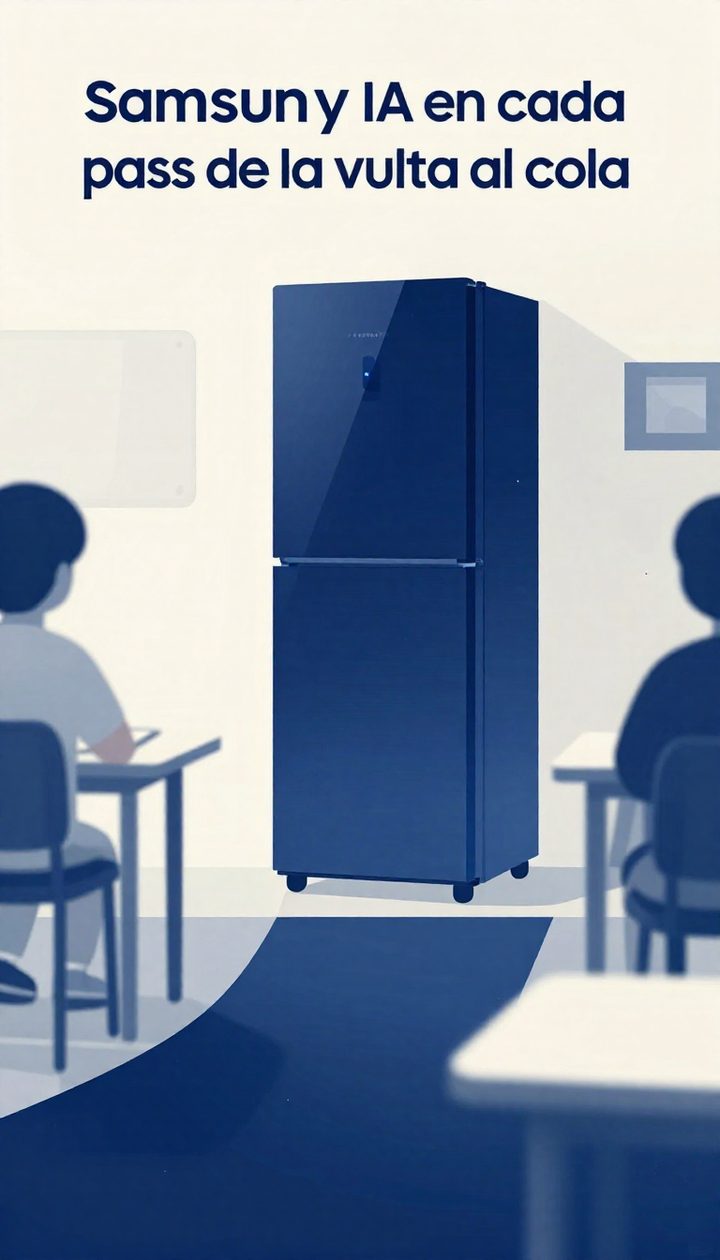
Samsung presents its 'back-to-school' guide with AI built into digital whiteboards, laptops, phones, watches and even fridges. There's no new product: it's a commercial packaging that reveals where Samsung wants AI to be invisible and constant in family life.
📚 Go deeper
The story of NVIDIA and Jensen Huang: how a video-game card company ended up making the most coveted resource on the planet.
As an Amazon Associate, Zendoric earns from qualifying purchases; the price does not change for you. · all our recommended books →
By Zendoric · July 22, 2026.
Samsung has published a back-to-school product guide that brings together, under the umbrella of artificial intelligence, almost its entire catalog: the WAFX-P interactive whiteboard for teachers, the Galaxy Book6 Pro laptop and the Galaxy S26 Ultra phone for students, the Galaxy Buds4 Pro earbuds, the Galaxy Watch8, and at home the Bespoke AI refrigerator with food recognition via Google Gemini and the Bespoke AI Laundry Combo washer-dryer. It is not the launch of any product: it is a marketing piece that packages already-existing launches under a narrative of seasonal convenience, according to Samsung Newsroom itself.
The most relevant detail, beyond the commercial wrapping, is in the classroom. The WAFX-P whiteboard incorporates the Samsung AI Assistant with features such as Circle to Search (searching by pointing with your finger on the screen), AI Summary (automatic summary of what was covered in class), AI Quiz (quiz generation) and Live Transcript, which transcribes the conversation in real time. Live Caption adds accessibility for students with hearing difficulties or those following the class in a second language. Samsung sells it as a way for the teacher not to have to step out of the flow of the class to organize content: the AI acts as a silent secretary while they keep teaching.
At the other end, the Galaxy Watch8 offers students personalized sleep coaching and activity tracking through Samsung Health, and the Bespoke AI fridge uses AI vision to identify what is inside and suggest menus. In other words: the same logic of algorithmic assistance applied to organizing a class is applied to organizing a teenager's sleep or a family's dinner.
It is worth being clear about what this is and what it is not. It is a promotional document, not an independent analysis of how well these tools work in a real classroom or how much they truly improve learning; Samsung provides no data on adoption, academic results or deployment figures in educational centers, and we have not found them in independent sources. The obvious comparison is with the rest of the industry: Google, Apple and Microsoft compete for the same ground, that of the assistant that slips into the school and family routine before the user actively decides they want it there.
There lies the angle that really matters. The public conversation about AI in education remains focused on the exhausted debate of "AI yes or AI no in the classroom"; Samsung, with this guide, takes for granted that the question is already settled and moves directly to the deployment hardware: whiteboards, laptops, watches. That shifts the debate to less publicly discussed ground: who owns the transcripts of what students say in class, what happens to the sleep and physical activity data of a minor captured by a watch sold as a school accessory, and under what safeguards that data is processed when the provider is, at the same time, the manufacturer of the hardware and of the cloud assistant. None of those questions appears in Samsung's note, which is unsurprising in a commercial text, but it is the part that an educational center or a family should demand before adopting these tools, not after.
Our reading connects with something we have already maintained about the education sector: the value is not in whether AI enters the classroom, but in whether it frees the teacher to do what an algorithm cannot —guide, motivate, detect who has fallen behind— instead of turning them into a supervisor of a system that decides for them what is relevant. Tools like AI Summary or Live Transcript, used well, can give teachers back time for judgment and the human relationship with the student, which is precisely what resists automation. Poorly deployed, without data governance or teacher training, they become another layer of surveillance normalized from childhood. The underlying optimism —a more personalized education, a future with more time for what matters— remains valid in the long term; but the short term requires that someone, before the manufacturer, decide what data on a twelve-year-old is worth capturing and who safeguards it.
📚 Go deeper
The definitive piece of investigative journalism on OpenAI: 260+ interviews, the clash between safety and speed, and the attempted firing of Sam Altma
DeepMind co-founder on the dilemma of containing technologies that do not want to be contained.
As an Amazon Associate, Zendoric earns from qualifying purchases; the price does not change for you. · all our recommended books →
🔗 Related on Zendoric
- Teaching AI by law: Mexico wants algorithmic ethics in the classroom before the chaos · 2026-07-13
- AI to retain teachers: when the algorithm acts as a critical mirror for school principals · 2026-07-01
- ESET joins the Agentic AI Foundation: cybersecurity gets a seat at the table where the agent standard is being carved up · 2026-07-02