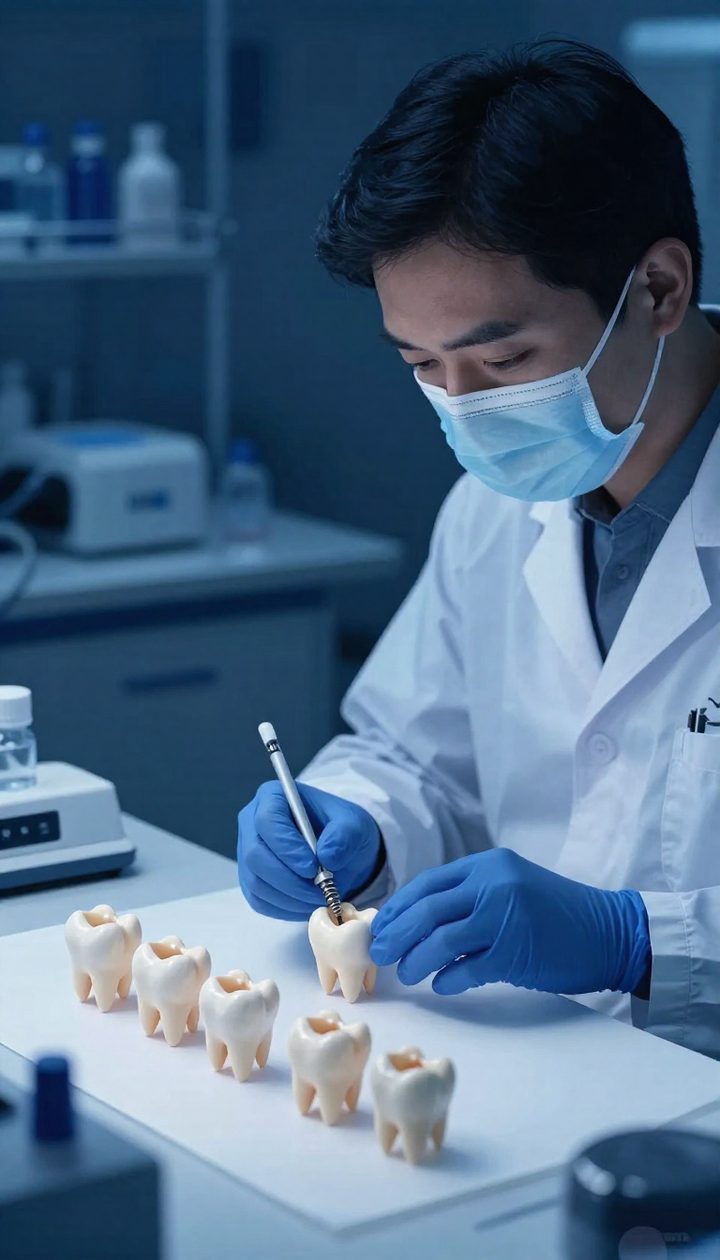
Scientists work on lab-grown teeth to replace fillings and implants
🕒 Published on Zendoric: July 21, 2026 · 00:20
✨ AI-generated · how it's made
Surveys cited in the article suggest that up to 70% of adults fear going to the dentist, leading many people to avoid check-ups and routine care.
📚 Go deeper

The only novel on the list, by a Nobel laureate: an artificial friend observes humans with a blend of lucidity and innocence no essay achieves.
As an Amazon Associate, Zendoric earns from qualifying purchases; the price does not change for you. · all our recommended books →
Surveys cited in the article suggest that up to 70% of adults fear going to the dentist, leading many people to avoid routine checkups and care. Faced with that fear and the limitations of current treatments, a growing group of scientists at various universities is applying regenerative medicine to dentistry, aiming for a future in which a dentist visit means regenerating damaged tooth tissue—or even an entire tooth—rather than repairing it with synthetic materials or extracting it.
Biochemist Hannele Ruohola-Baker, associate director of the Institute for Stem Cell and Regenerative Medicine at the University of Washington, says she receives messages almost daily from people asking to take part in experiments to regenerate their own teeth. As she explains, "people are ready for something new in dentistry."
The article emphasizes that teeth are more important to overall health than many people realize. Pamela Yelick, a professor at the Tufts School of Dental Medicine, describes them as "the window to the world": if someone is afraid to open their mouth or can't eat properly, they enter a downward spiral. It was historically underestimated that oral health is key to systemic health; today it is known that dental problems, such as the bacteria associated with gum disease, can increase the risk of heart disease and respiratory infections, and have even been linked to Alzheimer's. Tooth loss, meanwhile, is associated with greater illness and premature death, affects the ability to eat, chew and smile, and can harm social and emotional well-being—a cycle that sometimes begins in childhood.
Current fillings, made with materials such as resin composites, have highly variable durability—between roughly five and twenty years—and it is not uncommon for patients to need repeated interventions. Anne George, a professor of oral biology at the University of Illinois at Chicago, explains that these solutions focus on "repairing the damage" rather than "restoring biological function," so regenerative dentistry could represent a paradigm shift centered on healing.
One line of research focuses on cavities, the most common cause of tooth destruction. The tooth has four layers—enamel, dentin, cementum and dental pulp—and cavities arise when bacteria in plaque produce acids that first dissolve the enamel and then affect the softer dentin. George studies the proteins that help dentin grow, mineralize and repair itself, and her team cloned one of the genes involved in its formation; that knowledge could lead to treatments that stimulate damaged teeth to repair themselves with new dentin, eliminating the need for traditional fillings.
Ruohola-Baker's team is working on "living fillings" based on enamel. After studying donated wisdom teeth, they discovered that the cells that make enamel, called ameloblasts, die after the tooth erupts, so they can no longer be stimulated. Using chemical signals, they managed to convert stem cells into ameloblasts and odontoblasts (cells that produce dentin); combined in a lab dish, these cells generated a dental organoid capable of secreting enamel proteins on its own. Ruohola-Baker imagines that these proteins could be used to make fillings or applied directly to cracked teeth, though her long-term goal is a complete tooth grown in the lab, implanting the necessary cells in the patient's mouth and letting "nature do the rest."
When a tooth has extensive decay and deterioration, the usual solution is to extract it and place an implant, consisting of a screw, an artificial crown and a connector. But implants lack nerves that allow a person to feel while chewing, creating a risk of biting too hard and cracking them; in addition, bacteria can adhere to them and affect the remaining healthy teeth, and artificial crowns must be replaced roughly every 15 years, at a cost of thousands of dollars depending on insurance.
For that reason, some researchers are pursuing teeth grown entirely in the lab as a more durable alternative. Ana Angelova Volponi, director of regenerative dentistry at King's College London, advocates using a "biological replacement" rather than simply patching the damage, and her team is also developing an organoid capable of becoming a replacement tooth. Her group managed to get cells taken from adult human gum tissue, combined with tooth-forming cells from mice, to produce a hybrid human-mouse dental structure with viable developing roots. She is now working on recreating the biological instructions that guide that dental formation, along with biomaterials designed to help those cells organize into a functional dental structure.
Unlike other animals, humans cannot continuously regenerate teeth once their set of adult teeth is damaged. The article notes that sharks have an endless supply of teeth that renew like a conveyor belt, that kangaroos and elephants develop several sets of molars throughout their lives, and that pigs have a peculiar biological trait: their jaws contain multiple sets of adult tooth buds that have not yet erupted. Taking advantage of that feature, Yelick managed to grow human-looking teeth in adult Yucatan minipigs by combining human and porcine dental cells. Her team collected dentin-forming cells from human teeth and enamel-forming cells from unerupted teeth in pig jaws discarded by butchers—Yelick notes that even though a pig is slaughtered for consumption, its jaw contains tooth buds ready to form another tooth. After culturing these cells in the lab, the researchers combined them on a bioengineered scaffold that mimics the environment of a developing tooth, and after three months tooth-like structures formed at a rate close to the pig's natural dental growth rate. Yelick calls the result a "proof of principle" that the approach can work, and recounts that many people desperate to solve their own dental problems contacted her after the study became known; she is now seeking to repeat the experiment over a longer period and directly inside a pig's jaw, with the ultimate goal of inducing tooth growth in a person's mouth without using porcine cells.
Despite the interest and demand, the article is clear that it will still be years before anyone can undergo a self-regenerating filling or a lab-grown dental replacement. Ruohola-Baker notes that, before human studies can even be considered, it is necessary to experiment first with non-human primates, which will require more research, time and funding. In addition, to bring lab-grown teeth into the human mouth, researchers need to create improved environments for dental development. Meanwhile, according to Yelick, the lessons learned in regenerative dentistry—since teeth are "highly sophisticated living organs"—are helping to understand at a very basic level how hard and soft tissues interact, knowledge applicable to broader efforts in organ and bone regeneration. Volponi is confident that, although it won't happen soon, safe and sustainable regenerative dental solutions will eventually be available to the public: "that's where I see the future," she says; "it's not entirely clear, but it's hopeful."
📚 Go deeper

An MIT computer scientist connects AI, quantum physics and video games to take an uncomfortable question seriously: what if we live in a simulation? M
The memoir of the creator of ImageNet, the scientist who made the deep learning revolution in vision possible.
As an Amazon Associate, Zendoric earns from qualifying purchases; the price does not change for you. · all our recommended books →
🔗 Related on Zendoric