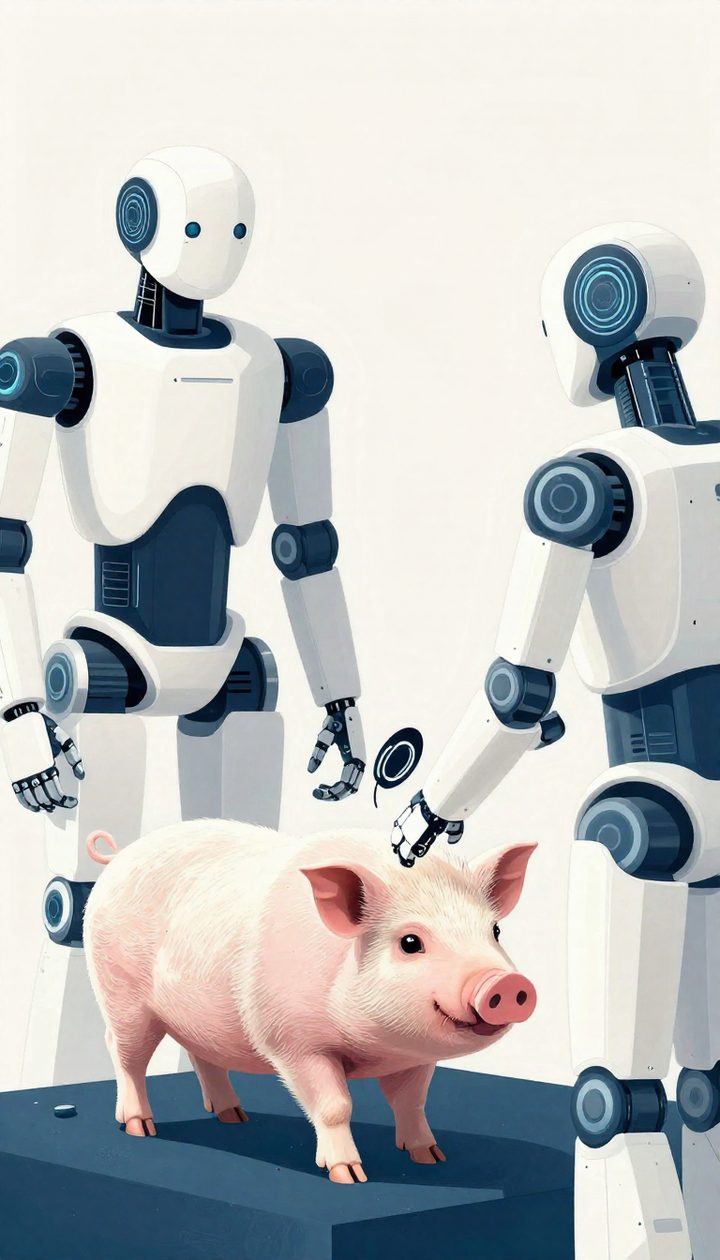
Teleoperated humanoid robots remove the gallbladder from live pigs in a pioneering remote-surgery trial
🕒 Published on Zendoric: July 11, 2026 · 00:27
✨ AI-generated · how it's made
A team at the University of California, San Diego has achieved a preclinical milestone published in the journal Nature: two humanoid robots, remotely controlled by human surgeons, successfully performed cholecystectomies (gallbladder removal) on live pigs using minimally…
📚 Go deeper

THE AI textbook: used by 1,500+ universities.
As an Amazon Associate, Zendoric earns from qualifying purchases; the price does not change for you. · all our recommended books →
A team at the University of California, San Diego has achieved a preclinical milestone published in the journal Nature: two humanoid robots, remotely controlled by human surgeons, successfully performed cholecystectomies (gallbladder removal) on live pigs using minimally invasive techniques. It is important to stress, as the article itself does, that these are not autonomous robots capable of replacing doctors: at all times it was expert surgeons who remotely controlled the machines' movements, in yet another example of human-robot collaboration rather than full automation.
The robot used is the Unitree G1, a humanoid made by the Chinese firm Unitree, a leader in robotics. According to the article, the cheapest base model, with barely functional hands, starts at around $13,500 (plus $300 to $1,200 for shipping), while adding key upgrades such as dexterous robotic hands can easily push the cost above $67,000. Even so, this figure is far lower than that of specialized surgical robots, such as Intuitive Surgical's da Vinci system, whose price ranges from half a million to several million dollars and which also weighs about 800 kilos (1,800 pounds), taking up far more space in the operating room. By contrast, the Unitree G1 measures 1.5 meters (5 feet) and weighs just 27 kilos (60 pounds), which would make it more suitable for small or remote clinical settings.
Shanglei Liu, assistant professor of surgery at the UC San Diego School of Medicine, told UC San Diego Today that the advantage of this approach is cost and space: 'It's a fraction of the cost and takes up a fraction of the space in an operating room [...] so it's easy to deploy, from rural areas to the battlefield and even space'. The underlying idea is that, if this approach can be shown to be clinically viable for human patients, it would allow surgeons to operate remotely in small hospitals and clinics that lack the resources to install specialized surgical robots such as the da Vinci, which does have FDA approval and has been tested in multiple clinical trials.
To make the experiment possible, the UC San Diego researchers had to build physical adapters that allowed the humanoid robots —nicknamed 'Surgie'— to hold surgical instruments, in addition to developing software capable of fluidly translating the surgeon's natural hand movements into movements of the tools attached to the robot's wrists. The surgeon operated from a console with a PC, a helmet-type stereoscopic display to view the scene and a pedal to activate or deactivate the connection between their hand movements and those of the robot. In the first surgery on a live pig, a human surgeon acted as an assistant alongside the robot; in the second, two teleoperated robots worked together.
The article honestly details the current limitations of this approach. The team had to stop the operation several times, for several minutes each time, to recalibrate the robots or to physically reposition their body or arm relative to the medical instruments, which made the surgery take much longer than with existing specialized surgical systems. The Unitree G1's limited reach also weighed in: its arms extend just 450 millimeters, compared with the 1.6 to 1.8 meter range of an adult human arm, which restricts the reach of remote operators. Added to this, other restrictions on the robot's range of motion, together with the need for frequent recalibrations, increased the cognitive and operational load on the surgical team, something the authors themselves consider far from ideal.
Another critical factor noted in the study is latency: current teleoperation systems for humanoid robots usually present delays of hundreds of milliseconds between the human operator's hand movement and the robot's response, while previous studies suggest that surgical robots should ideally stay below 150 milliseconds of latency to be safe in remote clinical scenarios. In addition, both novice surgical residents and experienced surgeons completed practice tasks faster when using the controls of the da Vinci Research Kit —the usual standard in telerobotic surgery— than when operating the humanoid robots.
Looking ahead, the team, which includes Michael Yip, professor of electrical and computer engineering at UC San Diego, continues to work on improving the system and is exploring the possibility of creating an 'autonomous surgical assistant' that could collaborate with human surgeons by performing general tasks, such as handing over instruments or even cleaning the operating room. Yip said that remotely operated and, eventually, autonomous humanoid robots have real potential to expand access to critical surgeries that many patients would otherwise be unable to obtain, which would help alleviate the healthcare crisis both in the United States and worldwide.
Nevertheless, the article itself recalls, citing previous Ars Technica interviews with robotics researchers, that there is broad consensus that general-purpose robots capable of working autonomously without human intervention —especially if they must operate safely near people— remain far from being a reality. In short, this is a relevant preclinical experiment that demonstrates the technical feasibility of using relatively cheap commercial humanoids as a platform for surgical teleoperation, but that also makes clear, with concrete data on times, recalibrations and latencies, how far this technology still is from real clinical use in human patients.
📚 Go deeper

The academic "bible" of deep learning, with a Turing Award winner among its authors, and legally free on the web.
The memoir of the creator of ImageNet, the scientist who made the deep learning revolution in vision possible.
As an Amazon Associate, Zendoric earns from qualifying purchases; the price does not change for you. · all our recommended books →
🔗 Related on Zendoric
- AI against cancer: Harvard's model hits 94% accuracy and China tests a vaccine that hasn't yet reached human trials · 2026-07-21
- Google unveils Gemini Robotics 2, an AI that coordinates the entire body of humanoid robots · 2026-07-31
- Google unveils Gemini Robotics 2, an AI that coordinates the full body of humanoid robots · 2026-08-31