The human body as a dataset: who really teaches robots to fold laundry
🕒 Published on Zendoric: June 27, 2026 · 09:00
Students and freelancers in Nigeria, India and Argentina film themselves ironing and scrubbing to train humanoids. Behind the robotic promise beats a global labor chain, frowned upon by families and loaded with questions about privacy and the distribution of value.
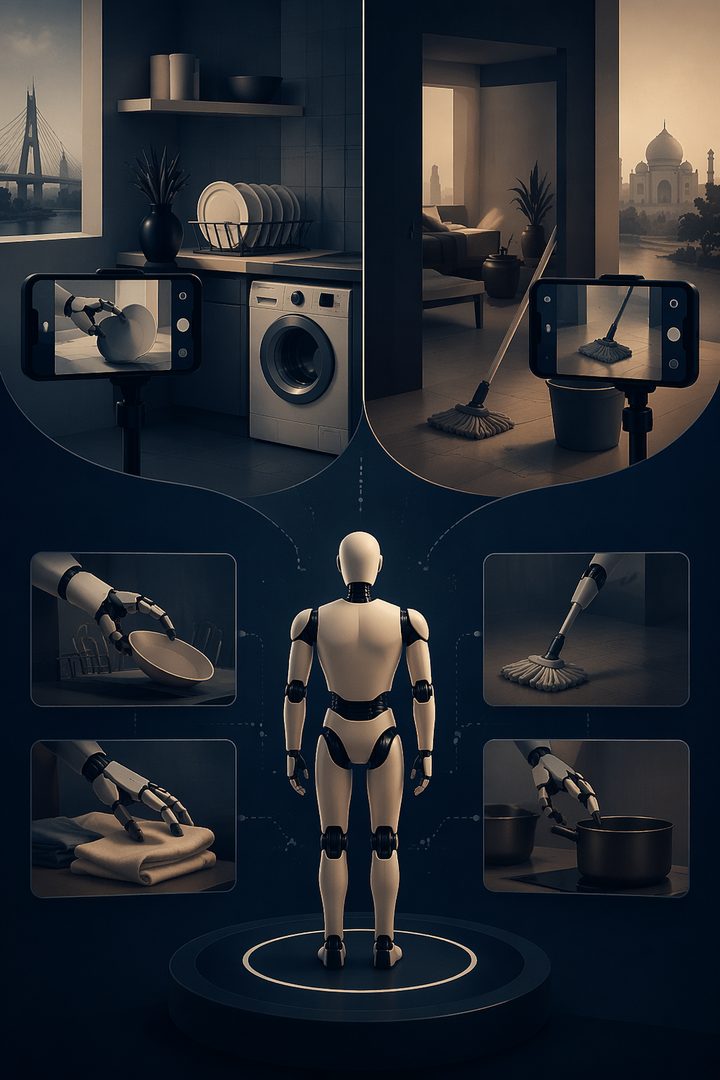
There is an image in this MIT Technology Review report, written by Michelle Kim on April 1, 2026, that sums up an entire era: Zeus, a medical student in Nigeria, walks through his apartment with his arms outstretched like a sleepwalker, an iPhone strapped to his forehead with a harness, so that his hands stay within the frame while he irons. This is not artistic performance. It is work: $15 an hour recording household chores that will be used to train humanoid robots.
The reason behind this improvised economy is technically revealing. Large language models learned by reading the internet, an ocean of text already available. Robots, by contrast, need data from the physical world —movements, forces, textures, positions— that is not published anywhere. Simulations work for acrobatics, but fail to model the precise gesture of grasping and moving a real object. Hence the only path is to capture real people doing real things. Physical data has become the bottleneck of robotics.
The figures the article provides sketch the scale of the phenomenon. Micro1, the Palo Alto company Zeus works for, has thousands of freelancers under contract in more than 50 countries; its CEO, Ali Ansari, estimates that robotics companies already spend more than $100 million a year buying real-world data. In 2025, according to the text, investors poured more than $6 billion into the humanoid sector. This is not a niche: it is a nascent industry with its own data supply chain, where Scale AI and Encord also compete, and in which even DoorDash pays its couriers to record themselves at home.
The most valuable thing about the report, however, is that it does not stop at the numbers. It gives voice to those who sustain this invisible infrastructure. Arjun, a tutor in Delhi, takes an hour to prepare a fifteen-minute video because the hard part is imagining what new task to record; he must also keep his two-year-old daughter out of frame. Sasha, a former banker in Nigeria, hangs the laundry stealthily so as not to capture her neighbors. Dattu, an engineering student in India, skips dinner to record himself folding the same clothes over and over under the incredulous gaze of his family: "To them it's like space technology." These are testimonies that humanize the data and lay bare its ambivalence: decent income in contexts of unemployment, yes, but also monotony and a social strangeness hard to explain to one's own.
The point that deserves the most reflection is privacy. Although Micro1 instructs workers not to show their faces or reveal personal data, every video inevitably opens an intimate window: the interior of the home, belongings, routines. Automatic filters and human review do not catch everything sensitive that slips through. As Yasmine Kotturi, a professor at the University of Maryland (Baltimore County), warns, it is essential that companies clearly inform workers about the use of what they record. Informed consent is not a formality, but the line separating a legitimate work opportunity from an opaque extraction.
The balanced conclusion is that we are looking at a foundational and little-recognized link in the robotics to come. It is worth celebrating that it generates income where it is scarce, demanding that it do so with fair standards of privacy and pay, and remembering —each time a humanoid folds a T-shirt with ease— that it learned to do so thanks to thousands of people who, in front of a home camera, taught it first.