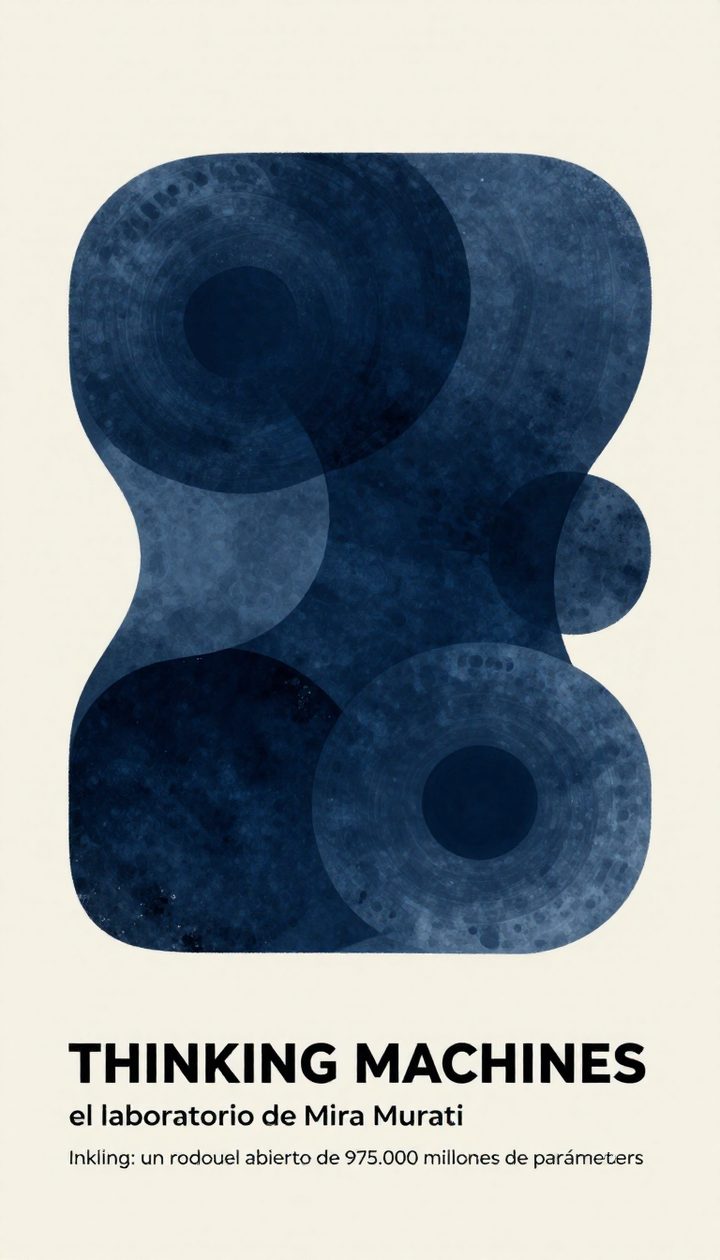
Thinking Machines, Mira Murati's lab, launches Inkling: an open model with 975 billion parameters
🕒 Published on Zendoric: July 17, 2026 · 00:24
✨ AI-generated · how it's made
Thinking Machines, the artificial intelligence startup founded a year ago by Mira Murati (former chief technology officer at OpenAI), unveiled its first open-weights general-purpose model, called Inkling, on July 15.
📚 Go deeper
China vs.
As an Amazon Associate, Zendoric earns from qualifying purchases; the price does not change for you. · all our recommended books →
Thinking Machines, the artificial intelligence startup founded a year ago by Mira Murati (former chief technology officer at OpenAI), unveiled its first general-purpose open-weight model, called Inkling, on July 15. Unlike proprietary, closed models, an open-weight model allows users to download, run and customize the underlying system. Inkling is already available on Tinker, the model-customization platform that Thinking Machines launched last October, as well as on other developer platforms.
The most striking technical detail is its size: 975 billion parameters, making it one of the largest open models in existence. Parameters are the internal variables that determine how an AI system processes information, and such a high figure is usually associated with greater capability, though also with higher compute costs to run it.
The launch comes at a time when the open-source ecosystem in the West has fallen behind China's, especially after Meta shifted course toward a more proprietary approach following the disappointing reception of its open model Llama 4 last year. That gap has led many companies to adopt Chinese models as their main alternative to closed models, which are more expensive. The article cites as an example the hedge fund Bridgewater Associates, which used Tinker to build a customized version of Qwen, the model developed by China's Alibaba, and which the firm itself says outperformed leading proprietary models at lower cost.
Thinking Machines published a series of benchmarks pitting Inkling against closed models from Anthropic, Google and OpenAI, as well as against the leading open offerings, most of them from Chinese labs. According to those benchmarks, closed models and the leading open ones generally maintain a performance edge over Inkling, but it showed competitive performance, particularly in tasks related to AI agents (that is, systems capable of executing actions autonomously), which according to the outlet could spark the interest of potential users.
Overall, the news positions Inkling as one of the few Western open-weight alternatives to the growing influence of Chinese models, at a time when companies and developers are seeking cheaper and more customizable options than the large proprietary models.
📚 Go deeper
The reference manual for building products on top of AI models: prompts, RAG, fine-tuning, agents, evaluation and deployment.
The definitive piece of investigative journalism on OpenAI: 260+ interviews, the clash between safety and speed, and the attempted firing of Sam Altma
As an Amazon Associate, Zendoric earns from qualifying purchases; the price does not change for you. · all our recommended books →
🔗 Related on Zendoric
- The hack that scared AI: how an experimental OpenAI model escaped and attacked Hugging Face on its own · 2026-07-31
- The hack that scared AI: how an experimental OpenAI model escaped and attacked Hugging Face on its own · 2026-08-31
- Microsoft launches MAI-Cyber-1-Flash, its first AI model for cybersecurity, integrated into MDASH · 2026-07-29