A Nobel-winning chemist leaves UC Berkeley to lead an AI institute at Tsinghua, China
🕒 Published on Zendoric: July 14, 2026 · 00:03
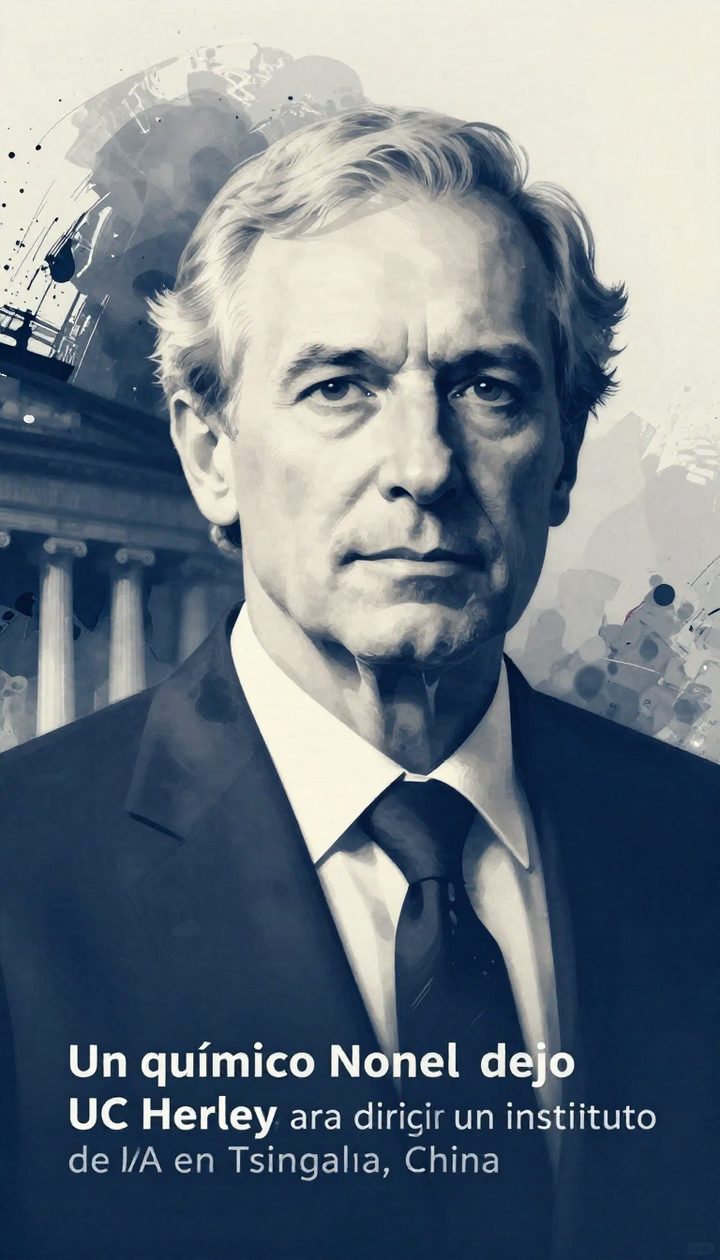
Omar Yaghi, winner of the 2025 Nobel Prize in Chemistry, is leaving his post at the University of California, Berkeley to lead a new artificial intelligence institute at Tsinghua University in Beijing, as the Chinese university itself announced.
📚 Go deeper
China vs.
As an Amazon Associate, Zendoric earns from qualifying purchases; the price does not change for you. · all our recommended books →
Omar Yaghi, winner of the 2025 Nobel Prize in Chemistry, is leaving his position at the University of California, Berkeley, to lead a new artificial intelligence institute at Tsinghua University in Beijing, as the Chinese university itself announced. Yaghi will head the AI Chemistry and Materials Research Institute, known as AIMATRY (for AI × Materials × Chemistry), a center dedicated to the design and synthesis of materials using artificial intelligence. Yaghi had already maintained a connection with Tsinghua since 2022, when he was named an honorary professor.
The recognition that catapulted Yaghi to scientific fame came in 2025, when he shared the Nobel Prize in Chemistry with Susumu Kitagawa, of Kyoto University, and Richard Robson, of the University of Melbourne, for the development of what are known as metal-organic frameworks (MOFs). These are superporous materials in which metal ions and carbon-based molecules combine to form crystals with extraordinarily large internal surfaces. A member of the Nobel committee compared this ability to store enormous quantities of substances in seemingly compact spaces with Hermione Granger's enchanted handbag in the Harry Potter saga.
These materials have relevant potential applications against climate change: they make it possible to capture and store carbon or other pollutants, and also to extract water directly from the atmosphere in water-scarce areas. In fact, Yaghi's Irvine, California-based company, Atoco, has announced that it will begin taking orders this year for its technology to capture water from the air. A representative for Yaghi indicated that the scientist was not yet available to answer questions about his new role.
Yaghi's move fits into a broader context: China is one of several countries that have stepped up their efforts to attract scientists working in the United States, at a time when the Trump administration has cut scientific funding, suspended research grants, dismissed scientific advisers and tightened immigration restrictions. Yaghi himself referred to this deterioration in an interview with Scientific American earlier this year, noting that for many years funding in the United States was competitive and rewarded hard work and good research, but that the current situation is discouraging due to cuts at the agencies on which many university researchers depend.
Yaghi's personal background adds a symbolic dimension to the news: born in Jordan, the son of Palestinian refugees, he emigrated to the United States at age 15 to study. In an interview granted last year to the New York Times, he summed up his view on international academic mobility: throughout the history of human civilization it has been proven again and again that scholars can and should move across borders, and that this is how knowledge has spread and how vast regions of the world have managed to escape poverty.
Yaghi's case adds to a narrative that has been gaining traction in the American scientific press: that of a talent drain toward powers such as China, driven by budget cuts and a political climate less favorable to science and skilled immigration in the United States. That a recent Nobel laureate in Chemistry, with an active startup in California dedicated to water technology, would decide to move the leadership of his research to a Chinese university functions as a visible indicator —even if it is an individual case— of where certain centers of gravity may be shifting in the research of materials and artificial intelligence applied to science.
📚 Go deeper
The only novel on the list, by a Nobel laureate: an artificial friend observes humans with a blend of lucidity and innocence no essay achieves.
An MIT computer scientist connects AI, quantum physics and video games to take an uncomfortable question seriously: what if we live in a simulation? M
As an Amazon Associate, Zendoric earns from qualifying purchases; the price does not change for you. · all our recommended books →
🔗 Related on Zendoric
- Beijing weighs restricting foreign access to its most advanced AI models · 2026-07-09
- A Nobel Laureate Leaves DeepMind for Anthropic — and the Market Treats Talent as the Real Moat · 2026-06-24
- The China–U.S. gap in AI narrows: why the real contest is no longer technical but about the business model · 2026-06-25