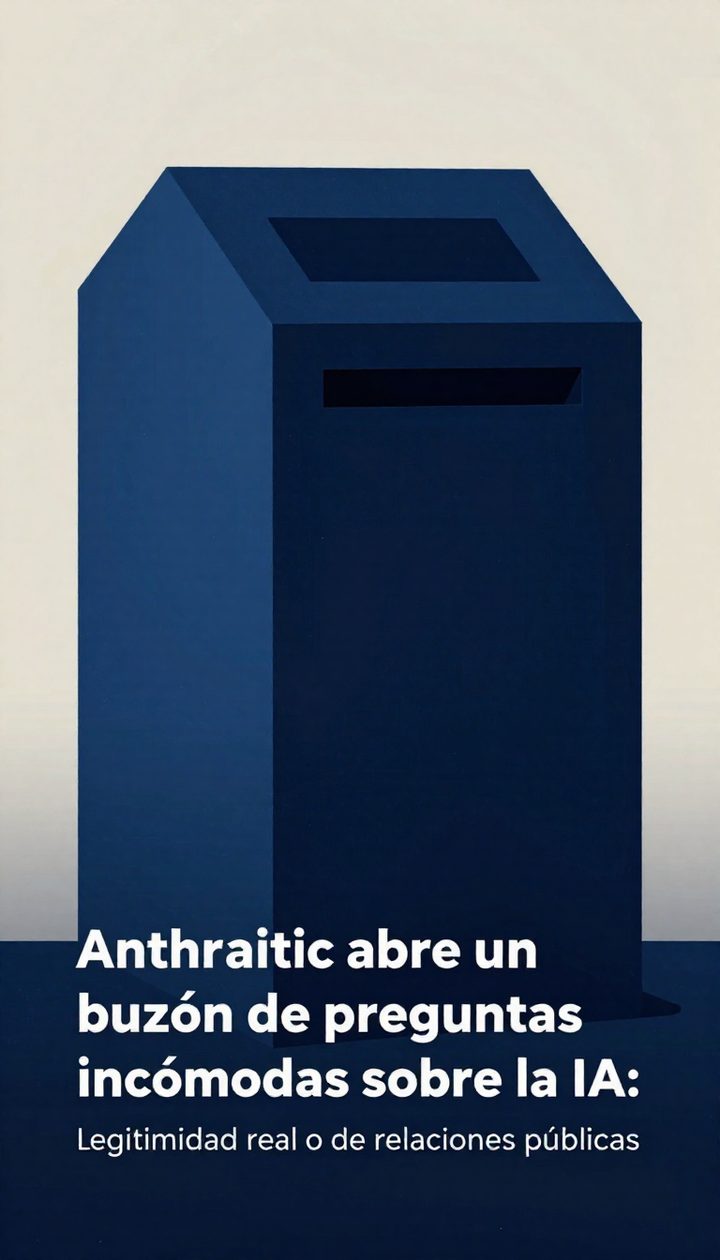
Anthropic opens a mailbox for uncomfortable questions about AI: real legitimacy or a PR gesture
🕒 Published on Zendoric: July 12, 2026 · 00:14
Anthropic is launching an initiative to collect the public's toughest doubts about AI's impact on jobs, society and science directly, and promises to publish what it does about them. It draws on surveys of tens of thousands of people, but the real test will come when it has to account for itself with facts, not press releases.
📚 Go deeper
The same bifurcation seen from the boardroom: strategy, execution and defensive moats to reorganize a business around AI before your competitors do.
As an Amazon Associate, Zendoric earns from qualifying purchases; the price does not change for you. · all our recommended books →
We'll send you a confirmation email (double opt-in). Privacy.
By Anthropic · July 11, 2026.
Anthropic, incorporated as a Public Benefit Corporation, has launched an initiative it calls "hard questions": it invites anyone to submit their toughest questions about how AI will affect employment, society, families and its role in science and medicine. The company commits to something uncommon in the sector: publicly disclosing what concrete actions it takes in response to those questions, and openly acknowledging when it falls short of its own goals. It is not an isolated gesture. Anthropic says it draws on prior listening work: the Anthropic Public Record, a survey of 52,000 Americans on their greatest hopes and fears about AI; the Anthropic Interviewer, with 81,000 Claude users across 159 countries; in-person focus groups; an internal research institute focused on AI's social challenges; and the Long-Term Benefit Trust, the corporate governance mechanism that in theory safeguards the company's public-interest mission above purely commercial interest. To this it adds existing programs, such as free access to its models for scientists and a fellowship for Claude users working at nonprofit organizations.
What is interesting is not so much the mechanism —surveying and promising transparency is cheap to announce— as the diagnosis Anthropic itself makes of public sentiment, which matches what we have been documenting at Zendoric for months, sector by sector: coexisting, without contradiction, are enthusiasm for a technology that accelerates science and solves complex problems, and a very concrete fear of job losses, the devaluation of creative work and the erosion of human decision-making capacity. That it is the very company selling the models that puts these concerns in its own statement, rather than leaving them to regulators or unions, is a sign of where the playing field is heading: social legitimacy has become a competitive asset as relevant as the benchmark of the day.
Our read is that this initiative is worth exactly as much as the actions that follow it, not the announcement itself. Anthropic builds its brand on safety and responsible governance —it is its differentiating angle against competitors like OpenAI or Google— and a public listening exercise fits perfectly into that positioning. But "promising to publish what we have done" is a yardstick the company sets for itself, without binding external audit beyond the Long-Term Benefit Trust, whose real capacity to halt commercial decisions has yet to be tested in a serious conflict of interest. The difference between this and other industries' corporate greenwashing will depend on whether, a year from now, there are product changes, deployment policy changes or investments in mitigating labor harms that can be pointed to by name, or whether the exercise remains a well-meaning summary of what people already thought.
Connecting this to the underlying thesis we hold at Zendoric: the fear of job loss and the erosion of human agency that Anthropic itself captures in its surveys is real and legitimate in the short term, and should not be minimized with easy optimism. But building public trust —through exercises like this, with all their limitations— is precisely the kind of social infrastructure needed for a society to accept and manage well a hard transition toward a horizon of abundance, where AI frees up time and resources rather than merely redistributing anxiety. Without that bridge of legitimacy, any technical advance —however promising in medicine or scientific discovery— runs the risk of running into social rejection that stalls even what is worth adopting. The value of this initiative, more than in the questions it receives, will be measured by whether Anthropic is capable of translating uncomfortable answers into decisions equally uncomfortable for its own business.
📚 Go deeper

A macroeconomic, sector-by-sector X-ray of how AI redraws the global chessboard over the coming decade, with the human factor at the center.

The best starting book if you're not technical: a Wharton professor explains how to work WITH AI — when to delegate, when to supervise, when to keep i
As an Amazon Associate, Zendoric earns from qualifying purchases; the price does not change for you. · all our recommended books →
🔗 Related on Zendoric
- Anthropic bets on trust as a brand: the ad campaign that turns fear of AI into a selling point · 2026-07-11
- Hartford bets on teaching AI to its young people before the job market leaves them behind · 2026-07-01
- Claude Science: Anthropic positions itself as the new DeepMind and takes direct aim at the pharmaceutical industry · 2026-07-01
Sources & references
Get the analysis by email · free
One email a day analysing the AI essentials. Free, no spam, unsubscribe anytime.
We'll send you a confirmation email (double opt-in). Privacy.