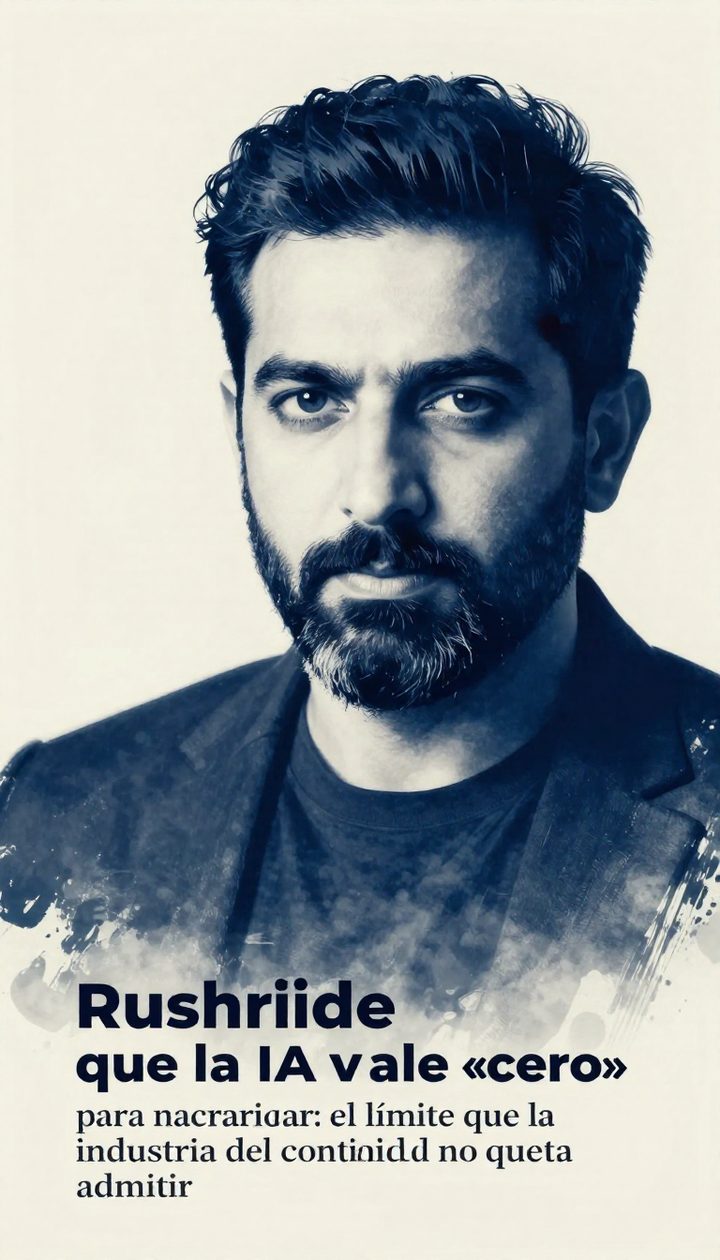
Rushdie says AI is worth 'zero' for storytelling: the limit the content industry won't admit
🕒 Published on Zendoric: July 9, 2026 · 00:21
✨ AI-generated · how it's made
In London, Salman Rushdie has settled the debate with a blunt phrase: AI has 'no' use for literary creation because it can only recycle what has already been written, never invent the unprecedented. He says it while negotiating new adaptations of 'Midnight's Children' and 'The Ground Beneath Her Feet' and preparing a documentary about the 2022 attack he suffered.
📚 Go deeper
How opaque algorithms decide who gets credit, a job or parole — and why they tend to punish the same people.
As an Amazon Associate, Zendoric earns from qualifying purchases; the price does not change for you. · all our recommended books →
By Variety · July 8, 2026.
Salman Rushdie did not mince words. Asked by Variety what role artificial intelligence should play in literary, cinematic or narrative creation in general, the author of 'The Satanic Verses' answered without hesitation: "Nothing. Zero." And he went further: "It's not useful for creative work because AI has no capacity for originality. What it can do is absorb enormous amounts of information and produce versions of that. But what it can't do is something that no one has done before. And that's art: finding things that people have not done before." The remarks came before Rushdie collected the 14th Liberatum Cultural Honour in London, in a conversation in which he also revealed there is renewed interest in a new television adaptation of 'Midnight's Children' (after the version with filmmaker Vishal Bhardwaj fell apart over financial and script reasons, with Netflix unhappy with the project's direction) and in bringing 'The Ground Beneath Her Feet' to the screen. Rushdie urged caution: "There are conversations about two or three of my books, but believe it when you see it." He also spoke about the documentary 'Knife: The Attempted Murder of Salman Rushdie', directed by Alex Gibney and based on his 2024 memoir about the 2022 attack he suffered, which premiered at Sundance in January and will arrive in the United Kingdom and the United States in September.
Rushdie's line is not the quip of a technophobic writer: it is the most widespread position among the great storytellers of our time, and it is worth taking seriously precisely because it comes from someone who has spent half his life defending the freedom to imagine against censorship, threat and violence. His technical argument, moreover, is defensible: today's language models are engines of statistical recombination over what already exists, optimized to produce the most probable continuation of a pattern, not to conceive a narrative structure, a voice or an idea that breaks with what came before. That, in essence, is what separates a text generator from an author: intention, risk and deliberate rupture with the expected.
That said, the word "zero" works better as a headline than as a complete diagnosis. That AI has no capacity for artistic originality does not mean it lacks any usefulness in the cultural production chain: it is already used for research, assisted translation, generating working scripts, dubbing, archive restoration or visual prototyping in audiovisual development, all of them mechanical, support tasks, not creative in the sense Rushdie defends. The entertainment sector itself lives that tension daily: while Rushdie dismisses AI outright, other industry voices —like Léa Seydoux, who in the same Variety coverage said she did not feel "threatened" by AI— place the discussion not on whether the tool is useful, but on what terrain it is allowed to enter and who controls that boundary.
This is where it connects with the underlying thesis we defend at Zendoric: in the short term, the anxiety of creators, screenwriters and actors in the face of generative AI is legitimate and should not be minimized, because there is already real pressure on rates, image rights and jobs in audiovisual production (Hollywood's own union standoff in recent years proves it). But the mistake would be to conclude that the technology replaces the author: what is threatened is the mechanical and repetitive work around creation, not the act of imagining something no one has done before, which remains exclusively human terrain and will probably remain so for a long time. If AI fulfills its promise of abundance —cutting the costs of production, editing and distribution— the long-term result should not be less human art, but more authors with more means to tell stories only they can conceive, while the machinery delegates to AI the tasks that were never the soul of the craft.
That Rushdie, at 79, is preparing a new novel "in an early phase," is again negotiating adaptations of his most ambitious works and continues to argue that art must unsettle and challenge is, at bottom, the best proof of his own argument: while machines learn to produce ever more convincing variations of what has already been written, literature will keep needing someone willing to risk their life, literally in his case, to say something that had not been said before.
📚 Go deeper
AI as the latest chapter in the history of information networks, from gossip to the printing press to the algorithm.
DeepMind co-founder on the dilemma of containing technologies that do not want to be contained.
As an Amazon Associate, Zendoric earns from qualifying purchases; the price does not change for you. · all our recommended books →
🔗 Related on Zendoric