Memory, the bottleneck for agents: Neo4j's proposal to break context into three layers
🕒 Published on Zendoric: June 26, 2026 · 09:00
Jim Webber, Chief Scientist at Neo4j, argues that agents fail in production not because of the model but because of their memory. His 'context graph' separates stable knowledge, volatile conversation and decision traces. A well-founded idea that deserves attention.
There is an increasingly shared diagnosis in the industry, and Neo4j states it clearly: the leap from chatbot to autonomous agent is not just a question of model, but of data infrastructure. According to Jim Webber, the company's Chief Scientist, today's systems stumble because their 'memory' is reduced to a conversation buffer and a static knowledge base; after several cycles, the agent loses track of the original plan and ends up doing something different from what it was asked. Anyone who has run agents on long tasks will recognize the symptom.
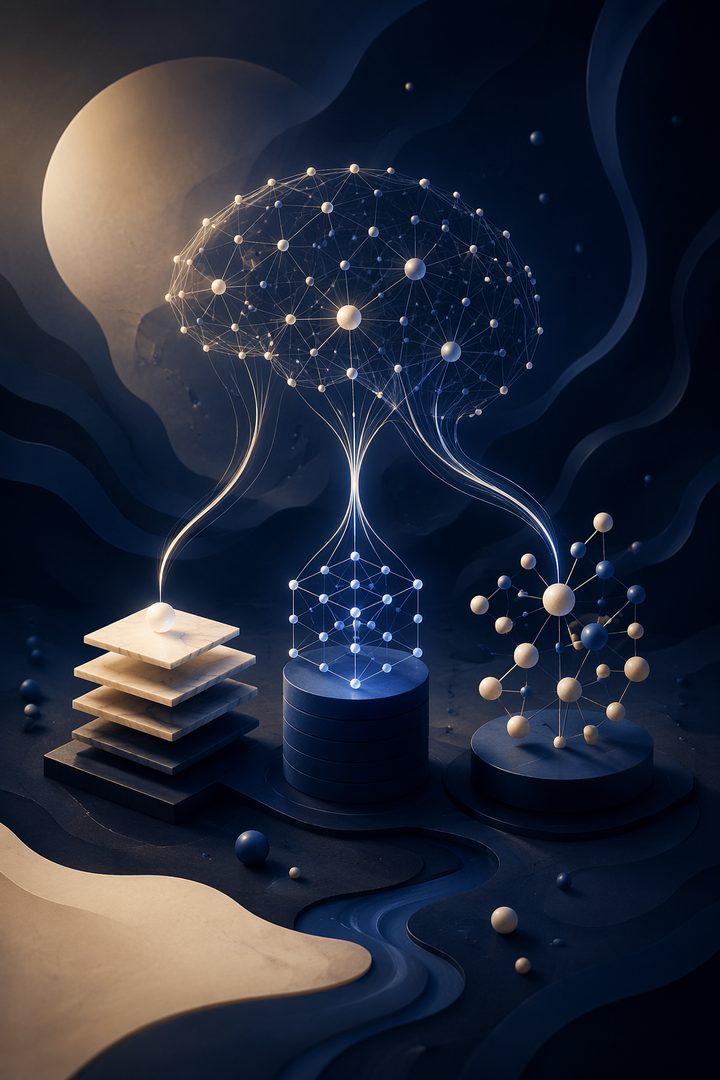
The proposal —the 'context graph', a pattern that Foundation Capital had already flagged as an architectural trend— offers an operational taxonomy instead of treating context as a monolithic block. Webber breaks it down into three layers. Long-term memory stores slow-moving enterprise knowledge (locations, molecular relationships, the state of a transport network): the 'domain truth' that corrects gaps in training and reduces hallucinations. Short-term memory manages the conversation history and the agent's state, preventing context drift and enabling multi-agent orchestration. And at the apex, decision traces record what the agent decided, why and with which tools.
That third layer is, in my view, the most valuable and the most underrated. Persisting reasoning in a structured way not only allows the agent to lean on its own past decisions to improve over time; it provides auditable transparency and explainability, a non-negotiable requirement in any serious enterprise deployment. Separating the three layers also makes sound engineering sense: each changes at a different pace and can be scaled and processed separately.
Neo4j backs the thesis with a product: Neo4j Agent Memory, an open-source library that packages the three memories, manages the graph schema and entity resolution, and integrates with LangChain, Pydantic AI, LlamaIndex, CrewAI and OpenAI Agents. It is worth reading with a cool head: the article is authored by the vendor of a graph database, and Webber himself admits that much of this was already possible with traditional graphs and Cypher; what is new is packaging it behind an API that saves writing queries. Memory management is one of the most active fronts of 2025-2026, with proposals such as Letta (formerly MemGPT), LangGraph or OpenAI's Memory tackling parts of the same problem. That a player with decades of experience in graphs contributes a clear, open abstraction is, in any case, a welcome contribution to a problem the industry has yet to solve.