ARBOR: when AI stops counting felled trees and starts identifying, one by one, those still standing
🕒 Published on Zendoric: June 25, 2026 · 09:00
Peru and the University of Sheffield present ARBOR, an AI trained on drone imagery that identifies, segments and geolocates individual shihuahuaco trees in the Amazon. The leap is no small thing: moving from detecting forest loss to cataloguing its presence, species by species, turns a legal mandate impossible to fulfill on foot into a scalable task.
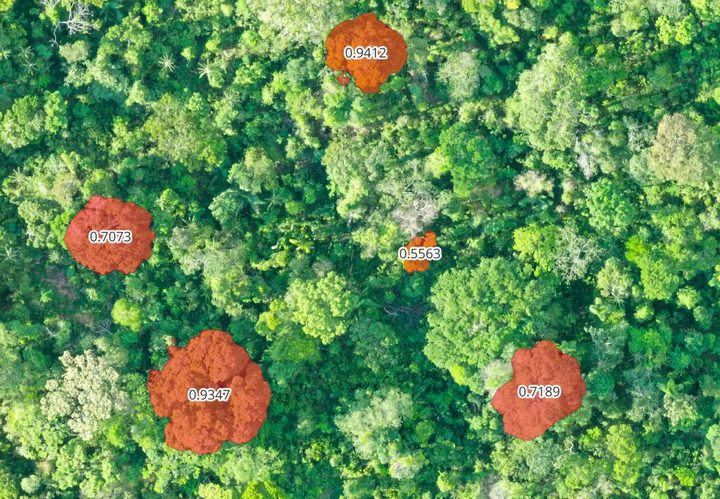
Some innovations are better understood through the change of question they propose. Traditional forest oversight asks 'what have we lost?' and measures deforestation. ARBOR, the artificial intelligence plugin presented by Peru's OSINFOR and the University of Sheffield, reverses the approach: 'what is still here, and of what species is it?'. Instead of detecting absences, it identifies, segments and geolocates presences —living trees classified by species— from images captured with drones. That shift, from cataloging losses to inventorying what exists, is the true core of the news.
In its first stage the tool was trained to recognize the shihuahuaco (Dipteryx micrantha), a species emblematic for its ecological value and its high price on international timber markets, included in Appendix II of CITES. And it was done with data from the field itself: a base of 176 high-resolution orthomosaics obtained through drone photogrammetry, with records of 1,883 trees, more than 700 of them shihuahuacos. This detail, which might seem technical, is decisive. One of the recurring failures of computer vision applied to tropical ecosystems is the mismatch between the training environment and the real one; training directly on Peruvian Amazon forests reduces that risk and increases the likelihood that the model will work where it truly matters.
Where ARBOR makes full sense is in its legal anchoring. Article 46 of the Forestry and Wildlife Law (Law No. 29763) requires 100% oversight of the harvesting of shihuahuaco. Fulfilling that mandate by sending inspectors to remote areas of the Amazon is, in practice, slow and extremely expensive. Here AI does not replace the law: it makes it enforceable. Automating identification and geolocation makes it possible to cover more area, more frequently and at lower cost, transforming a paper obligation into a real operational capability. It is the kind of application where technology does not promise to revolutionize anything abstract, but to resolve a concrete and verifiable bottleneck.
OSINFOR, moreover, is not showcasing a laboratory experiment. ARBOR was born in its OSINFORLAB —where an Edge AI-based fire detector and the Certificate of Legal Origin have already been developed— and coexists with ADETOP v2 Web, the algorithm that determines the legality of logging and which, according to the data presented at the event, has already been used in 181 cases. In the words of Williams Arellano Olano, head of the agency, collaboration with academia has made it possible to 'develop concrete solutions to improve the sustainable management of our forests'. That these models are applied to cases with real legal consequences is the best proof that the tool has crossed the border between demonstration and use.
The potential, which should be qualified with caution, points beyond Peru. Researcher Jefferson dos Santos, of Sheffield, stressed that the technology has 'the potential for impact not only in Peru's forests, but in other countries', and the presence at the event of authorities from SERFOR, Sernanp, the Ministry of the Environment and the Ucayali region suggests a vocation as a resource shared among institutions. The backdrop is serious: the Amazon lost more than 736,000 hectares to deforestation in 2025. Against that pressure, an AI capable of verifying the legal origin of timber and tracking CITES-regulated species is not a vague promise, but a strategic piece that links conservation, legality and efficiency. ARBOR illustrates well what artificial intelligence can offer when applied with its own data, clear objectives and a legal mandate behind it: not grandiloquent headlines, but a real capacity to enforce what was already written.