ASML and the $400 million machine that decides who builds the future
🕒 Published on Zendoric: June 25, 2026 · 09:00
It weighs 150 tons, costs $400 million and etches circuits at the scale of 40 atoms. ASML's new High-NA EUV is already heading to chip factories, and with it travels the physical bottleneck of the entire AI era.
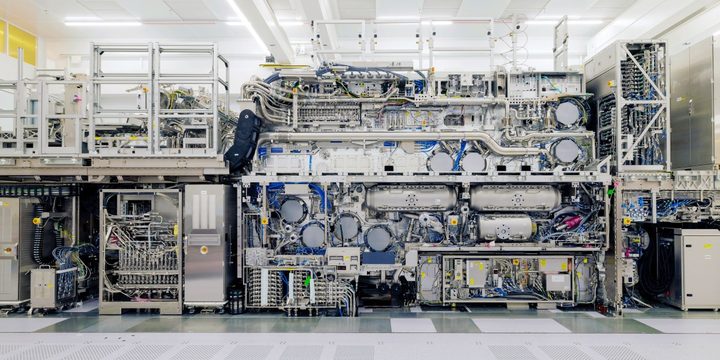
There are objects that condense an entire technological era into a single piece of engineering. ASML's new High-NA EUV lithography machine —the size of a double-decker bus, more than 150 tons, 400 million dollars per unit— is one of them. When its vice president of technology, Jos Benschop, admits that he sometimes looks at it and thinks "my God" after a decade designing it, he is describing something more than pride: he is describing the operational limit of what humanity knows how to build today.
What is fascinating about the account written by Clive Thompson in MIT Technology Review is how a second-tier Dutch company ended up controlling close to 90% of the world market. The key was not a stroke of luck, but an uncomfortable bet: around 2001, while Nikon and Canon were retreating in the face of the obstacles of extreme ultraviolet, ASML decided to send "thousands of engineers to hammer at the problem," in the words of analyst Jeff Koch. Sixteen years and some 10 billion dollars of R&D later, that stubbornness became a monopoly. It is a lesson worth underlining without falling into easy epic: deep technological leadership is rarely bought quickly; it accumulates problem by problem, in domains that rivals abandon because they seem impossible.
The feat of the new generation is elegant in its concept. Instead of seeking another light source —the most expensive step in lithography's historical cycle—, ASML has raised the numerical aperture from 0.33 to 0.55, which nearly triples transistor density. The price of that decision is physical and almost poetic: the light now strikes the three-dimensional mask at sharper angles and generates shadows, just like the low-angle sun in the Grand Canyon. The engineers' response was to stretch the geometry of the pattern and accelerate the mask to 22 g. Solving an optics problem by moving mass at accelerations no human could withstand sums up the character of this industry well.
It is worth putting the economic dimension into perspective with a clear head. The commercial takeoff of EUV coincided with the arrival of GPT-3 and ChatGPT, and the race to train models sent demand for elite chips soaring: ASML reportedly sold nearly 50 EUV machines in 2025 and approached 40 billion dollars in revenue. This matters because it reveals where the real bottleneck of artificial intelligence lies. It is not talent or data: it is the capacity to print transistors at eight nanometers, and that capacity today runs through a single company and a single machine.
Therein lies the geopolitical reading, which is worth treating with caution. Such extreme concentration grants ASML —and, by extension, the countries that regulate its exports— enormous leverage over who accesses the computing frontier. China and several startups are trying to break that dominance, and in the long term technological plurality would be healthy for everyone. But the history of EUV suggests that reaching this point requires more than a decade of patient capital and accepted failures. The future of chips, for now, still fits inside a single 200-cubic-meter artifact.