Immortal Thanks to AI? Longevity Escape Velocity, Without the Hype
✨ AI-generated · how it's made
Longevity Escape Velocity (LEV) is a serious scientific hypothesis, not a fairy tale: the moment when each year of research buys us more than a year of life expectancy. But there's an inconvenient detail almost no one mentions: the real demographic curve isn't accelerating today, it's slowing down. Our thesis: AI is genuinely compressing parts of drug discovery, but immortality isn't a compute problem — it's a problem of biology, clinical trials, and biomarkers that don't yet exist. The horizon is promising; the timeline, far humbler than what's being sold.
🎬 Our Short
📺 The full analysis on video (with chapters)
📚 Go deeper

The only novel on the list, by a Nobel laureate: an artificial friend observes humans with a blend of lucidity and innocence no essay achieves.
As an Amazon Associate, Zendoric earns from qualifying purchases; the price does not change for you. · all our recommended books →
The idea is so seductive it sells itself. "Longevity Escape Velocity" (LEV), popularized by Aubrey de Grey and Ray Kurzweil, describes a concrete threshold: the point at which medicine adds more than one year to your life expectancy for every year that passes. Cross it, and death by aging stops being destiny and becomes a technical problem you can defer indefinitely. It isn't magic — it's a falsifiable claim about the pace of science. And that is exactly why it deserves serious analysis, not a headline.
Start with what is actually happening, because it's genuinely remarkable. In drug discovery, AI has moved from promise to first clinical proof. Insilico Medicine published Phase IIa results in Nature Medicine (2025) for rentosertib (INS018_055), a TNIK inhibitor for idiopathic pulmonary fibrosis that is, per the company, the first drug both discovered and designed with AI to show an efficacy signal in humans: a mean improvement in lung function (+98.4 mL FVC at the high dose versus −20.3 mL on placebo). Insilico went public in Hong Kong in December 2025, with Eli Lilly and Tencent among its investors. In parallel, Isomorphic Labs — the Google DeepMind spin-off built on AlphaFold — raised a $2.1 billion Series B, signed with Johnson & Johnson, and Demis Hassabis announced at Davos (January 2026) that its first human trials would arrive by the end of 2026, with the stated ambition of "solving all disease."
Our reading: these milestones are real and deserve to be celebrated without condescension. AI is measurably shortening the slowest, costliest phase of the pipeline — from target to candidate molecule — which used to devour years. But we must separate two things marketing deliberately fuses: accelerating the design of a drug is not the same as accelerating its validation. And that is where the immortality narrative hits the wall.
The first collision is demography, and it is devastating for the euphoria. A 2025 PNAS study, led from the University of Wisconsin-Madison across 23 wealthy countries using six independent methods, concludes that life-expectancy gains have decelerated sharply. The WHO put 2025 global life expectancy at roughly 73.5 years, barely 0.2 more than in 2024, versus nearly half a year annually at the start of the century. The authors go so far as to state that no generation born after 1939 is expected to average 100 years. Plainly: for LEV to exist, this curve would have to bend upward, and today it does exactly the opposite. Escape velocity is measured by acceleration — and acceleration, for now, is negative.
The second collision is the biological bottlenecks, which AI does not dissolve by decree. In animal rejuvenation, De Grey's LEV Foundation closed its mouse-combination study in February 2026: they call it a "qualified win," with interventions adding over 30% lifespan extension in aggregate, but without hitting the milestone De Grey himself deems the only one that matters — adding twelve months of life to an already old mouse. He maintains a 50% probability of reaching LEV in the mid-to-late 2030s; worth logging as the forecast of an advocate, not a scientific consensus. In partial cellular reprogramming, Altos Labs — funded with billions from Bezos and others — published solid science (reversing the "mesenchymal drift" of aging, in Cell, 2025), hired Joan Mannick as chief medical officer and, per industry press, reportedly began human safety testing in 2025; but it still has no approvals, no revenue, and no broad clinical data. And senolytics, the great hope of "clearing" senescent cells, remain unconvincing: the pilot trial of dasatinib plus quercetin in adults at risk of Alzheimer's (eBioMedicine/Lancet, 2025) was small, safe, but without an efficacy signal.
There is a third, less visible and decisive bottleneck: we don't know how to measure aging well. Epigenetic clocks — AI algorithms over DNA methylation — are the star tool, yet as of today none is validated by a regulator as a surrogate endpoint for longevity trials, and several papers warn they are unreliable at the individual level. Without an accepted biomarker, every anti-aging therapy must prove its effect on specific diseases or mortality, which returns the clock to the scale of classic trials: years, large cohorts, hard outcomes. AI can propose a thousand molecules by morning; human biology still responds at its own pace.
This is where our editorial line applies: qualified, long-term optimism. In the short term, three real problems. One, the risk of selling dates: "immortality in 15 years" is an aspiration, not a datum, and conflating them feeds everything from supplement scams to consumer epigenetic clocks that promise more than they can deliver. Two, inequality: if the first rejuvenation therapies arrive, they'll be expensive and scarce, and a longevity gap between rich and poor would be the most obscene inequality imaginable. Three, the fixation on defeating death can divert resources from what we already know works — prevention, public health, cutting the child mortality that, per the PNAS study itself, explains much of the slowdown.
And in the long term, the optimistic nuance is sincere, not a compromise. The underlying logic of LEV — treating aging as the common risk factor of nearly all chronic disease, rather than as destiny — is scientifically reasonable and increasingly well funded. AI is a genuine multiplier on the part of the problem it knows how to solve: exploring chemical space, predicting structures, generating hypotheses. The most likely outcome isn't immortality but something more modest and perhaps more valuable: compressing morbidity — gaining healthy years before total years. That an AI-designed drug already moves real patients' lung function is proof of concept that this path exists.
The practical implication, for our readers, is twofold. As citizens, we should push the conversation from "will we be immortal?" to "which avoidable deaths can we tackle now, and who will pay for the therapies that arrive?" As technology watchers, the indicator to track isn't the next lab headline but three boring, honest signals: whether any age biomarker earns regulatory validation, whether AI drugs clear Phase III (not just IIa), and whether the demographic curve finally stops decelerating. The day all three move together, LEV will have gone from wish to live hypothesis. We're not there. But for the first time, the question has stopped being science fiction and become a problem of engineering and calendar. And that, in itself, is enormous news.
📚 Go deeper
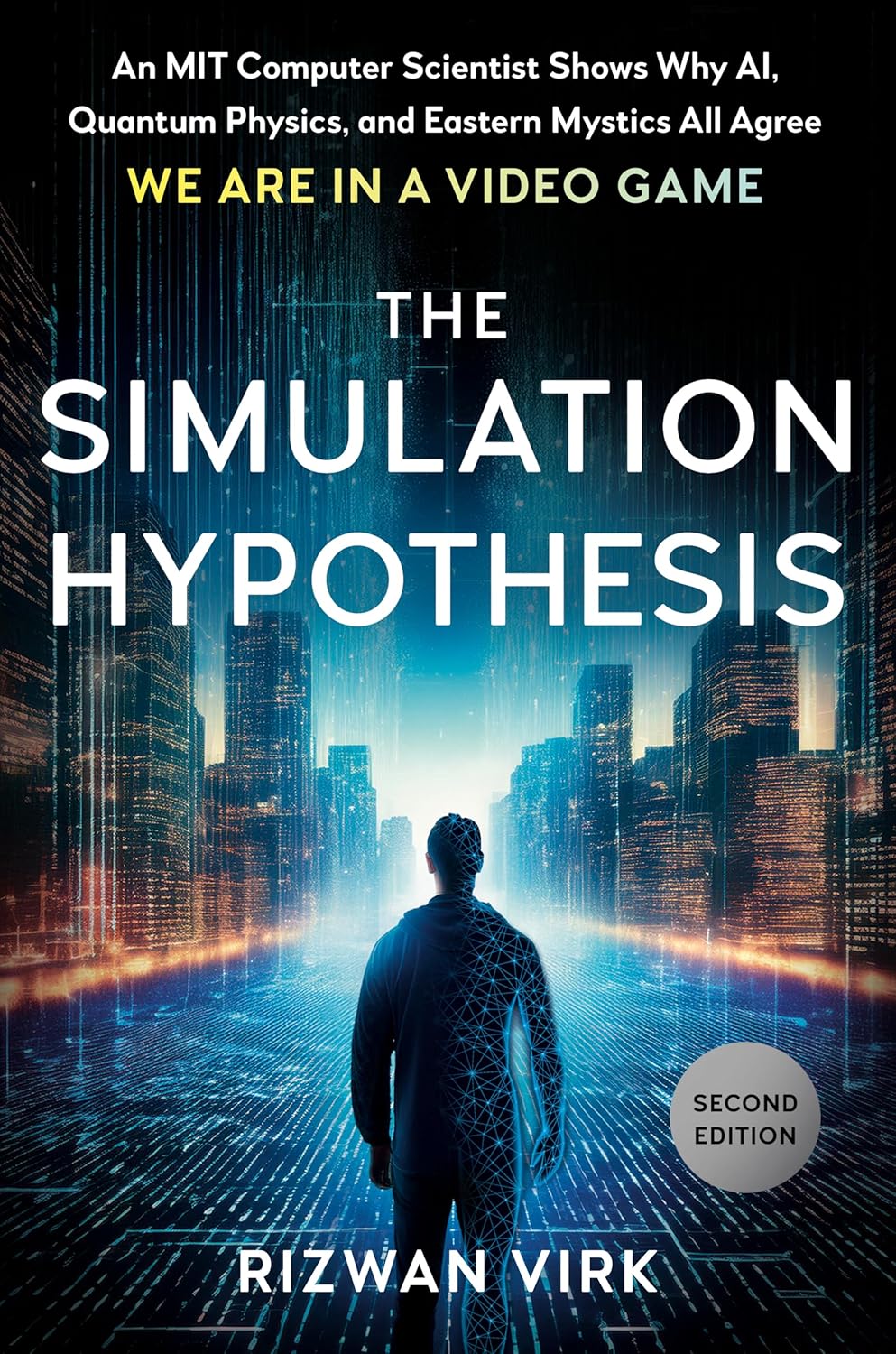
An MIT computer scientist connects AI, quantum physics and video games to take an uncomfortable question seriously: what if we live in a simulation? M

DeepMind co-founder on the dilemma of containing technologies that do not want to be contained.
As an Amazon Associate, Zendoric earns from qualifying purchases; the price does not change for you. · all our recommended books →
Sources & references
- LEV Foundation — Longevity Escape Velocity Foundation
- Cohort mortality forecasts indicate signs of deceleration in life expectancy gains (PNAS, 2025)
- Life expectancy gains have slowed sharply, study finds (ScienceDaily)
- Insilico Announces Nature Medicine Publication of Phase IIa Results of Rentosertib (TNIK inhibitor, IPF)
- 'An AlphaFold 4' — scientists marvel at DeepMind drug spin-off's new AI (Nature)
- Alphabet spin-off Isomorphic Labs raises $2.1B to 'solve all disease' (R&D World)
- Prevalent mesenchymal drift in aging and disease is reversed by partial reprogramming (Cell, 2025)
- Is Altos Labs gearing up for clinical trials? (Longevity.Technology)